
Make-A-Difference at Ya’anna: Lila Rodriguez-Aceves Brings Land-Based Learning to Caltech
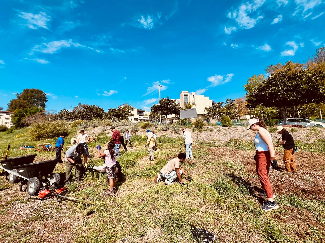
Ya’anna Village land tenders—including several from Caltech—prepare the soil for planting and ceremony. (Photo: Damian R. Wilson)
On April 12th, as part of Make-A-Difference (MAD) Day with the Caltech Y, seven other Caltech community members and I joined Lila Rodriguez-Aceves at the Chief Ya’anna Regenerative Learning Village—12 acres of unceded land in El Sereno, about 20 minutes from campus, where we helped tend the land. The Ya’anna Village is the first parcel of land returned to the Gabrielino Shoshone Nation, one of the original Indigenous peoples of Los Angeles. It is stewarded in partnership with Anawakalmekak, the first and only Indigenous public K-12 school in California.
Lila, who is Nawa, graduated from Anawakalmekak after attending from kindergarten through the twelfth grade. She is now a first-year student in the Environmental Science and Engineering option, pursuing the chemistry track, and plans to add a second major in History with a focus on pre-colonial Latin America. She also conducts research in the Tejada Lab.
Duty-bound, Lila arrived at Caltech with a mission. “People in my community deserve to have a rigorous education like Caltech and have access to all the resources the institution can provide,” she said. “I got involved with the Y my first term—immediately.”
She began by bringing Caltech tutors to Anawakalmekak. “It took us first term to organize tutoring,” Lila recalled. “Then last term, we took some students to go and tutor the high schoolers. We don’t have many AP classes or honors courses—especially in math. That’s why I became involved—and [the Y has] been supportive of helping my community and bringing these resources to the students.”
Next came the land work. Ya’anna hosts a monthly Land Tending Day, drawing in local volunteers for hands-on care. “My school’s been doing Land Tending Days since they started taking care of Ya’anna Village, to get El Sereno and other communities involved in land-based learning,” Lila explained. “They were doing a Land Tending Day the same day as MAD Day, and I reached out to some people to tell them this is something we’re doing with MAD Day, and if you’d be interested.”
Two primary motivations guided her: family, and a desire to deepen Caltech’s engagement with Indigenous communities. “My brother is the assistant land manager of Ya’anna, and I thought it would be really great in the Caltech community,” Lila said. “Caltech is very isolated to Pasadena and what’s going on in Pasadena, even though El Sereno is just 15-20 minutes away.”
Her devotion to reciprocity is clear: “Me coming to Caltech has always been about: How do I give back to my community? How do I give my resources to them after graduation and while I’m here? Oh, I can help my community by bringing volunteers there and helping them with whatever they’re doing. But it would also broaden the worldview of people here at Caltech to other things going on.”
Lila stressed the extent to which Indigenous science is often overlooked, and how much events like MAD Day can showcase its richness. “I want to show people that our science is holistic, sustainable, and valuable. A lot of that is working with the land, preparing the land for the corn, the way we water—that’s all science,” she emphasized. “And being here at Caltech, I can give my community here to share their science, and bring my science to them, so we can create the most efficient and sustainable solutions.”
She gave an example: “We plant close to the well so instead of electricity, we typically just use gravity, and the physics of just how to work with the land. You plant diagonally, the water will come down. They look like puzzles—the way it moves. If we have rows going this way, the water will continue to move without any real implementation of how to do. The water’s our tool, and we learn how to do it in the most efficient way.”
Tilling the soil, as I learned while at Ya’anna, is far more than a mechanical act of cultivation—a ceremonial practice that Lila instead describes as a reawakening of the land. Rather than imposing upon the earth, this process honors its vitality and spirit. In this way, the land is understood as more than inert matter to be exploited, but a living relative to be awakened, nourished, and thanked.
This ethos of interconnectedness—between land, people, and knowledge—is central to Ya’anna’s teachings. “Nothing in the way we work and believe and have our science is singular. Everything works together, just like the people,” Lila said. “It proves to be the most productive and efficient way of growing the food.” This interconnectedness extends beyond soil to the very structure of community: I’ve learned so much from what it means to be part of this growing culture. And I see it very much reflected in our people. The elders are always the people who hold it up; the youth are always the ones who continuously grow from the knowledge we have.”
Lila’s own growth is rooted in that cycle of reciprocity. “When I grew corn for the first time, it was a gift back to my parents for graduation: Thank you for giving me this. I’m going to move on to the next stage of my life, which is Caltech, and continue to have that knowledge which is important to me and to them.” For her, planting is more than tradition—it’s a way of healing generational wounds and re-establishing belonging. “It’s also about them returning to their roots. Not just our children, but our parents and elders feeling safe in their Indigeneity, which was once taken away.”
The Caltech Y has been instrumental in supporting Lila’s work. Liz Jackman, Associate Director of Student Programs at the Y, helped coordinate a relationship between Caltech and Ya’anna. “I think the Y is really about student leadership,” Liz said. “I see our role, or the part I find most exciting about my role, is seeing students who have this vision and just supporting it to make it a reality. Because they’re really the ones who are making it happen.”
In her interview with the Tech, Liz was effusive in her admiration for Lila. “I just want to sing her praises! Lila’s amazing because she’s a frosh, right? I met her really early on. She just stopped by the Caltech Y table and is so passionate about her school and wanting to give back—just to do something for her community.”
Liz noted how intentional Lila has been in building meaningful partnerships: “I think sometimes with service, you can do more harm than good. You need to be careful when you do it. And I think [Lila] knows the community and knows how to serve the community in a meaningful way. It’s just impressive!”
And Lila’s work is just beginning. “Caltech should do a better job with its Indigenous people—not just partnership, but uplifting sovereignty—just 20 minutes away, where these spaces are working as hard as they can to flourish,” she said. “I don’t think Caltech is doing enough, but I’m grateful for Caltech Y for giving me these resources and letting me do this work. And I can see it flourishing in the next four years that I’m here.”
Those interested in participating can find monthly Land Tending Day announcements on Ya’anna’s Instagram account, @regenvillage, as dates vary each month.