
What is Love?
It’s 2:17 a.m., and here, time—so rigid during daylight, dictated by the unyielding rhythm of schedules and the steady ticking of laboratory clocks—has become fluid, expanding and contracting with the beat of my thoughts. I sit cross-legged on the windowsill of my Caltech dorm, my knees pressed against the cold glass, staring out at a city that sparkles with flickering lights and unformed aspirations. In the stillness of these early hours, with a mug of tea cooling beside me, the world falls quiet enough for the oldest questions to resonate more powerfully: What is love, if it even exists?
The question lingers in my mind, relentless and stubborn. Maybe it’s because of two students I saw earlier today, holding hands under the olive trees, their fingers intertwined as if to ground themselves amidst the chaos. Or it could be the recollection of my mother’s daily messages—soft reminders to eat, take breaks, and be gentle with myself. Her love, a fabric made of small, continuous acts, now feels like a missing part of me. Amid Caltech’s brilliant intellect and unwavering demands, I sense this absence more than ever.
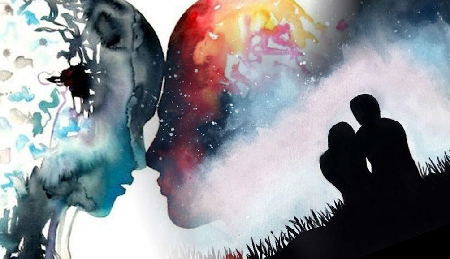
Image from “The Philosophy of Love: Can We Learn How to Love?” By Nicole Becker, TheCollector, March 29, 2023.
Is love something we can touch—skin against skin, the warmth of a hand—or is it found in the softness of a voice, the tenderness of a name spoken? Could it be both, or perhaps neither? In his Symposium, Plato characterizes love (eros) as a yearning for wholeness, a quest for our “other half” (Symposium, 385–370 BCE). He posits that we are incomplete, and we aim to achieve completeness in our pursuit of love. However, in the solitude that colors these academic halls, I ponder whether love is less about fulfillment and more about recognition: to be seen, acknowledged, and cherished for who we truly are.
As I flip through my notebook, I find a line marked in red: “We accept the love we think we deserve.” (Stephen Chbosky, The Perks of Being a Wallflower). Is this why many of us, even among Caltech’s most brilliant, settle for so little? We make jokes about being “emotionally unavailable,” treating self-protection as a badge of honor instead of recognizing it as a sign of fear, of wanting too much, of loving without receiving love in return. Reflecting this existential conflict, Sartre stated, “Freedom is what you do with what’s been done to you” (Existentialism Is a Humanism). Our past influences our decisions regarding love and vulnerability, yet we possess the freedom to rise above them.
I remember a childhood dawn: at twelve, I rode my horse while the world glowed in golden tranquility. In that moment, I felt profoundly connected—not just to the horse, but to the earth and something larger and kinder. Was it love, or merely a transient feeling of belonging? C.S. Lewis noted, “Affection is responsible for nine-tenths of whatever solid and durable happiness there is in our lives.” (The Four Loves, 1960). Maybe love is less about grand displays and more about the quiet, enduring connections we nurture—a friend’s laughter, the comfort of being truly understood.
Still, I yearn for something more profound: the type of love Rilke depicted, “to be a world for oneself and for another at the same time” (Letters to a Young Poet). Is this kind of closeness attainable, or are we inherently solitary beings? Jean-Paul Sartre cautioned, “Hell is other people” (No Exit, 1944), implying that genuine mutual understanding is elusive. Yet, Simone de Beauvoir argued, “One is not born, but rather becomes, a woman” (The Second Sex, 1949), and perhaps through becoming—through connecting and caring—we cultivate a love that transcends solitude.
At Caltech, love seldom appears grand. It manifests in my lab partner bringing me cold brew during intense calculations, Kayane’s voice resonating in the vacant auditorium, and Lindsay saving a front-row seat for me because she knows I dislike sitting at the back. Love is reflected in the swim team captain’s encouraging notes before a meet, my suitemate’s chamomile tea on sleepless nights, and in the professor who remembers my name. Toni Morrison says, “Love is or it ain’t. Thin love ain’t love at all” (Beloved, 1987). Here, amidst equations and fatigue, I long for the profound love that arrives, persists, and doesn’t need to be loud to be authentic.
However, love is also defined by absence and yearning: the friend who gradually disappears, the ignored messages, and the loneliness that sets in as others pair off, forcing you to observe someone else’s happiness. In this light, love assumes a different form: self-love. Audre Lorde pointed out, “Caring for myself is not self-indulgence, it is self-preservation, and that is an act of political warfare.” (A Burst of Light, 1988). Amid constant pressures, prioritizing self-care—making the bed, taking medication, embracing imperfections—emerges as a profoundly radical act.
But what about the love that dwells in longing? The unspoken agony of wishing to be understood, chosen, and acknowledged? Kierkegaard, the father of existentialism, stated, “To cheat oneself out of love is the most terrible deception; it is an eternal loss for which there is no reparation, either in time or in eternity” (Works of Love, 1847). At Caltech, a place where brilliant minds strive to uncover the secrets of the universe, perhaps the most significant challenge lies in understanding the intricacies of our hearts and daring to embrace vulnerability in an environment that expects continuous competence and self-sufficiency.
As I stroll through the Caltech campus at dusk, I’m intrigued by the contradiction of being close yet distant. We walk the same paths, attend the same lectures, and struggle with identical challenging assignments, yet each of us navigates our internal worlds. In his influential book I and Thou, Martin Buber suggested that true love—and indeed any authentic relationship—necessitates an “I-Thou” interaction, a moment in which we encounter another not merely as an object, but as a living entity. Amidst the hustle between labs and lectures, how often do we genuinely acknowledge one another? When I pass friends in the corridor, I ponder: are we merely exchanging an “I-It” glance, or do we occasionally find ourselves in that sacred, ephemeral “I-Thou" moment, where love quietly resides? There is significance when you gaze at me; engage with me, see me for who I truly am.
Some nights, the pursuit of understanding becomes overwhelming, and the city’s lights outside my window flicker with unresolved questions. In these moments of solitude, I feel the wisdom of Hannah Arendt, who stated, “Love, by its very nature, is unworldly, and it is for this reason rather than its rarity that it is not only apolitical but antipolitical, perhaps the most powerful of all antipolitical human forces.” (The Human Condition, 1958). In the incessant pursuit of achievement that defines Caltech, love emerges as a subversive force—a reminder that our worth isn’t determined by publications or problem sets, but by our ability to care, to take a moment, and to create connections that defy commodification and competition.
As dawn seeps through the city, painting gold across the glass, I realize that love at Caltech is both a rebellion and a refuge. It is rebellion in how we carve out moments for one another, despite the pressure always to do more, be more, know more. It is refuge in the gentle rituals we build: the late-night study sessions that turn into philosophy debates, the shared playlists passed like secret notes, the comfort of silence in a friend’s presence when words fail. Perhaps love is less a destination and more a practice—a daily choice, as Aristotle might say, to cultivate virtue through small acts of kindness and recognition. In this, love becomes not an answer to be solved, but a way of being in the world, even—or especially—here, among the dreaming spires of Caltech.
As life buzzes outside my window tonight, I understand that love exists in countless small moments: laughter, music, quiet togetherness, and the enduring hope that tomorrow holds promise. Nietzsche once mused, “Invisible threads are the strongest ties” (Human, All Too Human, 1878). Maybe love isn’t just an answer; it’s a question worth revisiting in every act of kindness, every look shared, every aspiration that reassures us we are not alone.
If you had asked me ten years ago about love, I might have filled the margins of my math notebook with heart drawings, crafting dreams of soulmates and fairy tales. Now, at twenty, love seems less like a thunderstorm and more akin to light rain: gentle, steady, and nurturing in ways I never anticipated. The journey continues, with each day at Caltech revealing a new piece of the puzzle. For now, it’s enough to believe that love exists—not as a certainty, but as a possibility. In the pursuit of this question, perhaps we will uncover what we truly seek.
Because, in the end, love is not the solution to the equation, but the equation itself—an ever-evolving proof that we work out in the margins of our lives, hoping that one day, the answer will appear, beautiful and authentic.