
Opposition
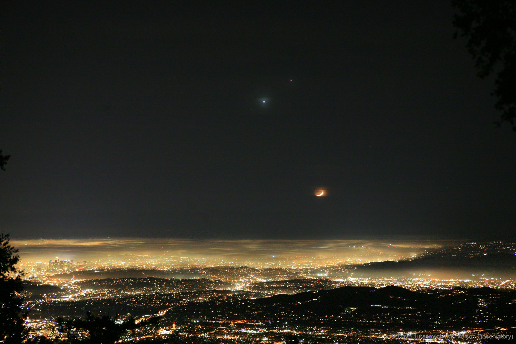
“A Happy Sky Over Los Angeles,” 2017. (Photo: Dave Jurasevich)
Jupiter was getting brighter than I’d ever seen it, brighter in real terms, closer to the earth, than it had been since 1963. And not only was it getting closer than ever, the online forums said it would be in “opposition”—directly opposite the sun from the earth’s perspective, like a full moon, only a full Jupiter—the on the same night that it would draw closest to the earth, the night of September 26, 2022. And as though that weren’t perfect enough, my wife and I now had a working 8 inch reflector telescope, and my best friend in the city, Elijah, was coming over as well. Together we would make an evening of hanging out in the dark on our back patio in Eagle Rock, seeing what we could of Jupiter during its closest pass by the earth in nearly 60 years.
My mom’s old astronomy textbook from college opens with a great line: “In astronomy one observes when one can, not when one wishes.” And it looked like the window for us to observe was about to open wide. The scope we’d acquired was a family heirloom, a Schmidt-Cassgrain with an 8 inch mirror, manufactured by Celestron in 1981. With its burnt orange tube, gorgeous setting circles, and Byers gear powered by an analog drive module, it’s an instrument from another era. This telescope lived in my parents’ closet under a veil of crumpled plastic for most of my childhood. About three or four times in my life my dad got it out to show us globular clusters, star nurseries, and, what I remember most clearly from a camping trip under a dark sky, the ghostly-white annulus of the Ring Nebula. But for the most part the scope remained off limits, under plastic, in the closet.
Then, in early 2021, my wife and I found out we were pregnant. On a whim I asked my dad if I might be able to have the family telescope. Maybe I shouldn’t have been surprised when he joyfully replied, “that’s probably optimal.”
After making the trek from Denver to L.A. the telescope sat untouched for months, like a holy artifact, in the corner of our home office. Every now and then I would unlock the declination and right ascension clamps and pivot the scope around. But the truth is that I was intimidated by it. Then, in late spring a friend invited us out to Johnson Valley for the summer solstice. How cool it would be to get the scope all cleaned up for a desert sky on the shortest night of the year! So I gloved up, grabbed some rubbing alcohol, and set to work. That’s when I noticed corrosion on the secondary mirror, clusters of little black specs.
To get a better look, I would have to free the secondary mirror from its place in the middle of the corrector plate, the big glass lens at the front of the scope. I hadn’t read the owner’s manual with any thoroughness at all, but I was determined not to be intimidated. I set to work loosening the three declination screws that held the mirror in place. Astronomy people will cringe along with me now when I tell you that when I got the last screw free the secondary mirror dropped directly into the primary mirror. Horrified, I removed the lens at the front of the scope and attempted to reach down into the tube to retrieve the mirror. In doing this I accidentally slid the secondary mirror across the primary mirror, adding more scratches to both. I finally managed to retrieve the secondary mirror, but not before I’d done irreparable damage to the very heart of the instrument.
I was crushed. I called my dad straight away to tell him, and to beg for his forgiveness. To my great surprise and relief he did not sound mad on the phone. He told me that while scratches weren’t great, they wouldn’t do all that much damage to the mirror’s ability to gather light, and that dust and dirt, not scratches, were the great enemies of astronomy. Humbled and relieved, I sealed the secondary mirror and corrector plate in ziplock bags and bubble wrap and looked to see if Celestron was still in the business of telescope repair.
It took me six months to work up the courage to take the scope in for repairs. To my amazement and relief Celestron accepted it, cleaned it, and reassembled it like new. The scratches on the primary mirror and corrosion on the secondary remain, but as I would find out, an imperfect scope with well aligned mirrors and a solid mount can still pull signs and wonders out of the L.A. sky.
The solstice was now long past, but an even more special astronomical event was on the horizon, Jupiter in opposition and at perigee, historic perigee, on the same night. The weather forecast was good, the sky was clear, the scope was clean, the mirrors were aligned, the sun was setting, and the universe was coming out. That’s when Elijah called to tell me that because of a forgotten commitment he was not going to be able to make it. His reasons were legitimate, but disappointing nonetheless. There we were, set up for ideal viewing of the greatest Jovan event in a half century, a rite of passage for me as a novice astronomer, thwarted at the last moment by a single calendrical snafu. One observes when one can, not when one wishes.
Still, my wife and I got to see mighty Jupiter that night in all its brilliant oppositional light, its storming belts contrasting its white teaming zones. That was the night I first understood the significance of opposition. Jupiter gleamed in the eyepiece. Its moons pierced the darkness of space. And every now and then a moment of clarity in the midnight air unconcealed the legendary storm on the southern band setting now over the planet’s leading limb. The window was open, and the target, bright and livid, was vaulting high and clear over our meridian. And there we were, with gears, mirrors, and lenses, watching the miracle unfold.
On the phone that evening I invited Elijah over an encore session the following night. Sure, Jupiter would be a day past prime superposition, but the view would still be outstanding. He obliged, and after we’d waited for the sky to darken and the planet rise high in the sky, Elijah took his first look in the eyepiece. He exclaimed over the planet’s supreme brightness, its bands, etc. But then he remarked that one of the Galilean moons seemed to be closing in on the planet’s trailing limb. He was right. Within minutes the pinprick of that moon was encroaching on the edge of Jupiter’s disk, appearing almost to warp the limb around itself as it moved inward. I had read about this—transit, a moon of Jupiter making transit across the apparent disk of the planet.
But I hadn’t counted on witnessing such a thing. And it wasn’t just the moon. Was there another moon starting a transit? No! It was the shadow of the moon. Here we were, expecting a modestly faded re-run of the previous night’s event, but now a whole new spectacle was unfolding. Ganymede, the queen of the Galilean moons, was racing its own shadow over Jupiter’s very cloud tops. I do not know if the transit lasted an hour or longer, but to witness that silent event, a double initiation into the mysteries of Jovan ephemerides—I now know why some people dedicate their lives to astronomy.
Ancient and medieval philosophers speak of the “spectacle” of truth. The highest truth, they say, is not something given to us to understand. It is, rather, something that, on occasion, unconceals itself so that we might behold it momentarily before it conceals itself again. Something was unconcealed to me in those short hours when the window to Jupiter’s bright brilliance was opened to us. That the sky is a world of events, some of which we may, in the short span of our lives, be granted to witness. That despite the oppositional forces of bad weather, amateur ineptitude, damaged instruments, and quotidian life’s myriad obligations, there will still come spectacular solar, lunar, planetary, stellar and even cosmic events in which we are invited, by the simple virtue of our being a part of this universe, to participate.