
The Importance of Earnest Theater Criticism: TACIT's Wild(ean) Triumph
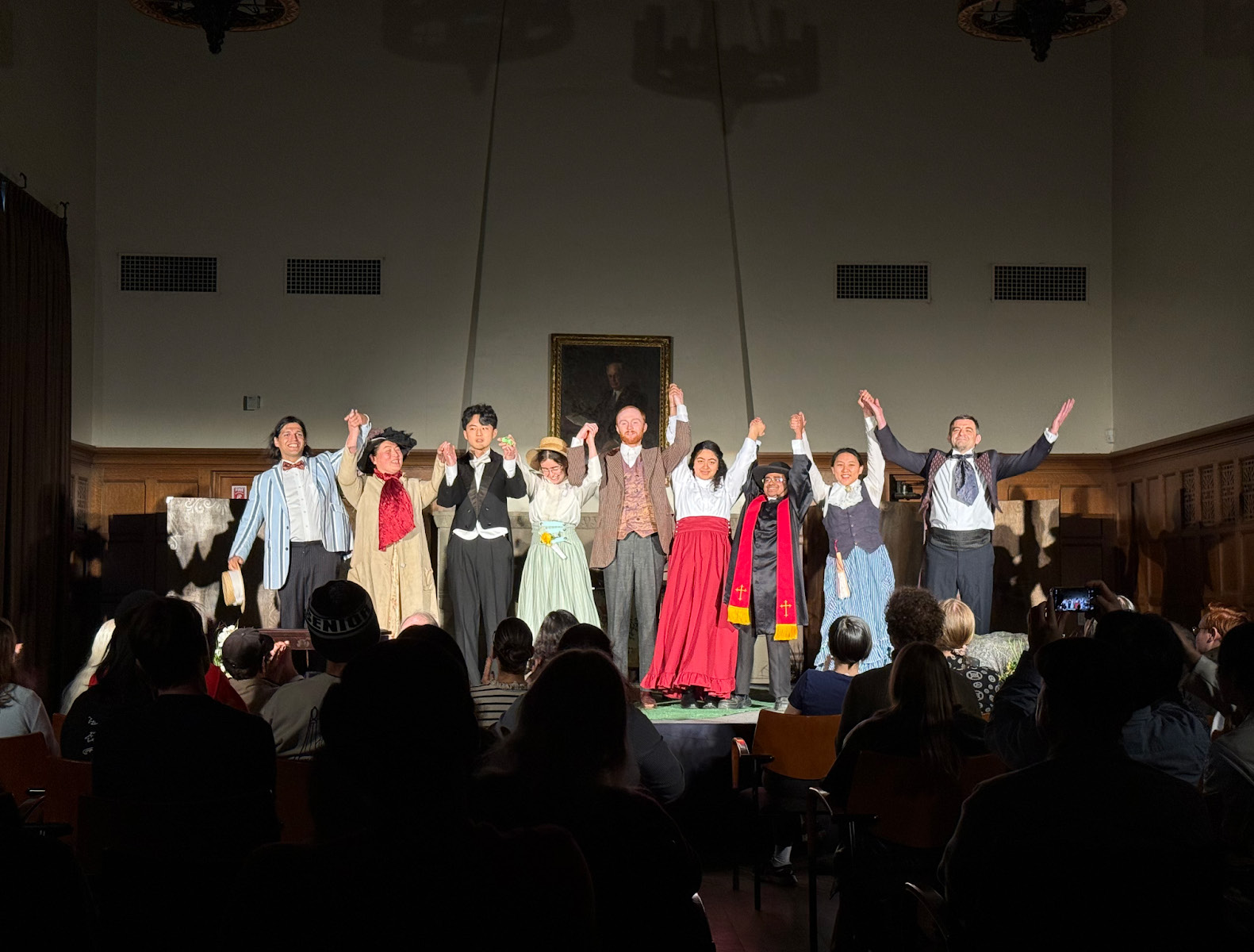 Cast of Earnest, from left to right: Max Gorbachev, Tiffany Kim, Jin Park, Sarah Madden, Solvin Sigurdson, Mahak Mathur, Ankan Mukherjee, Joyce Kim, and Marcin Kurowski. (Photo: Charity Hume)
Oscar Wilde subtitled The Importance of Being Earnest “A Trivial Comedy for Serious People,” but the Theater Arts at Caltech (TACIT) cast made clear in their recent production that the inverse is equally applicable: a serious comedy for people who can appreciate some well-placed triviality. Under the constraints of a shoe-string budget and the time pressures of the term (with just a month between the first read and the premiere!), the ensemble delivered a spirited, genuinely funny performance that embraced both Wilde’s wit and its own Caltech quirks.
As Algernon Moncrieff, Max Gorbachev anchored the play with playful nonchalance. He delivered Algy’s cruelty and blithe selfishness (“My dear boy, I love hearing my relations abused…”) with a charm that skirted the edge of sincerity, exactly as the role demands. Opposite him, Solvin Sigurdson’s John Worthing found the right blend of exasperation and earnestness, shining especially in the scenes where Jack’s façade begins to unravel. Together, Gorbachev and Sigurdson captured the hilarious futility of two men who insist on being named Ernest while being anything but.
Sarah Madden’s Cecily Cardew and Mahak Mathur’s Gwendolen Fairfax formed one of the evening’s comic high points. Their duet of polite hostility—trauma-bonding over the elaborate deceptions of their suitors—was sharply timed (and dressed!). Each played up the absurdity of the “girlish dream” to marry on such a bizarre and singular predicate, with Cecily’s ingenuous romanticism and Gwendolen’s iconic pretension clashing and harmonizing in equal measure. Their reconciliation, upon their lovers’ less-than-Ernest revelations, landed with genuine warmth.
As Augusta Bracknell, Tiffany Kim strode through each scene with the hauteur of a woman who has never once doubted her authority. Her interrogation sequences were especially memorable: treating smoking as a viable occupation, extolling the beauty of ignorance (“like a delicate exotic fruit—touch it and the bloom is gone”), and recoiling with delightful horror at the notion of “marrying into a cloak-room.” Kim’s Bracknell hit the precise balance between satire and self-seriousness that keeps the role evergreen.
Ankan Mukherjee, as Rev. Frederick Chasuble, leaned into the character’s affable awkwardness. His gentle conflict between clerical duty and budding romantic feelings for Miss Prism was played with a charming sincerity, offering softer comic beats that complemented the show’s verbal pyrotechnics. Opposite him, Joyce Kim’s Laetitia Prism brought a well-modulated mix of propriety and longing; her precise physicality made every scene with Chasuble quietly delightful.
Rounding out the cast were Marcin Kurowski as Lane and Jin Park as Merriman: the indispensable straight men to the chaos of the upper classes. Both actors delivered crisp, understated performances, grounding the production with wry facial expressions and perfectly timed silences. Their dry reactions sharpened the absurdity around them, integral as they were to the show’s farcical texture.
To be sure, the text’s funniest sharpest comic threads—Algy’s scathing impishness (“Divorces are made in Heaven”), Jack’s exasperation at Cecily’s imaginings, Lady Bracknell’s sweeping pronouncements, and the exquisitely trivial crises of names and manners—were woven with a precision that would have pleased Wilde himself. Sigurdson, especially, stood out: “Some aunts are tall, some aunts are not tall” struck its mark, as did Jack’s horrified confession of being “found in a handbag”—or “at any rate bred” in one.
Some actors might have benefitted from more time to polish accents or snap certain cues more tightly, but such imperfections never overshadowed the charm of the production. If anything, they only heightened the Wildean energy: earnest, unpretentious, and joyfully committed.
The set—assembled with Caltech ingenuity on minimal funds—was impressively conceived, offering warm Victorian interiors with just enough ornament to suggest Wilde’s world without (Bun)burying itself in excess. The costumes, too, provided moments of visual humor, with Algernon’s Beetlejuice-esque look underscoring his glibly demonic aura. As Gorbachev’s character quips, “If I am occasionally a little over-dressed, I make up for it by being always immensely over-educated”—a line that felt right at home on the Caltech stage.
TACIT’s The Importance of Being Earnest may not have been a flawless period piece, but it fully succeeded where it mattered: in revealing Wilde’s comedy to be anything but trivial. The cast embraced the silliness, the sharpness, and the quiet sincerity beneath the play’s many layers of artifice. The result was an evening as clever as it was heartfelt—an earnest celebration of theatrical joy, Caltech-style.