
The Entropy of the Heart: A Report From the Caltech Mirage
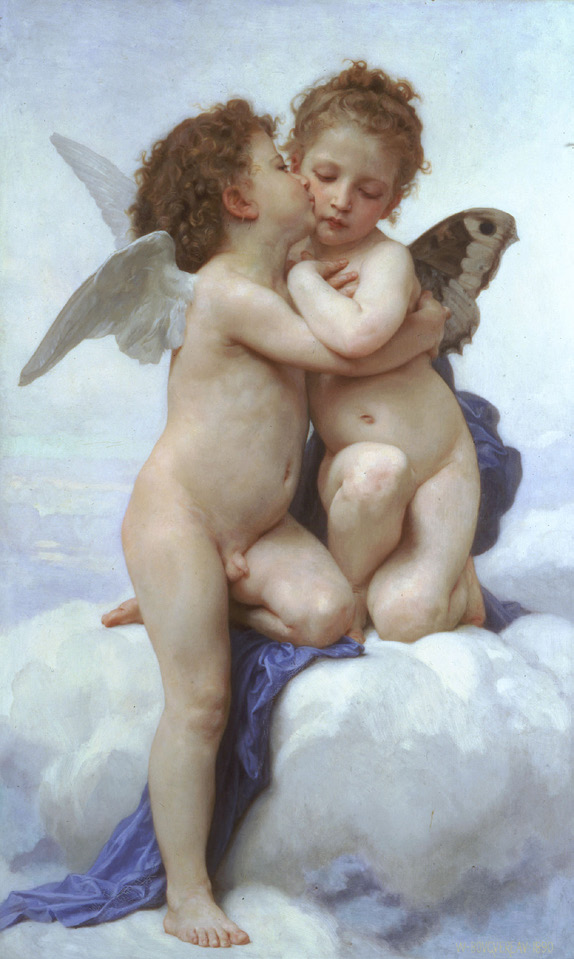
William Adolphe Bouguereau, “L’Amour et Psyché, enfants,” 1890.
I am currently sitting in front of my computer, definitely too late considering that I have to wake up at 6… and it is already the a.m., with me staring at a problem set that I intuitively understand is unsolvable, much like the broader equation of my life.
There is a specific kind of silence that settles over Pasadena in the early morning. It is heavy, dense with the unvoiced anxieties of a thousand overachievers wondering if they are frauds. I feel this silence not just around me, but inside me. It echoes against the walls of my chest where I suspect something vital has atrophied.
Satire and sorrow Recently, a satirical piece regarding the “Caltech Mirage” has been circulating. It is meant to be funny. But as I read it, I felt that familiar ache—the friction between the joke and the terrifying reality underneath it.
“You are not alone. Many have succumbed to the Caltech Mirage: an unfortunate phenomenon in which repeated exposure to the same few faces begins to warp the soul. Suddenly, you’re impressed with the fact that they held the door open for you at Red Door.”
The author calls this a “warping of the soul.” They frame it as a lowering of standards, a “proximity-induced hallucination.” They laugh at the idea that we might find romance here simply because our sample size is n=3. But when I read this, I don’t see a hallucination. I see desperation for connection in a vacuum. I see Kierkegaard’s “fear and trembling” playing out in the cafeteria line. The satire suggests we settle because we are bored. I argue we settle because we are terrified.
Existentialist philosopher Jean-Paul Sartre famously said, “Hell is other people.” But at Caltech, hell is often the absence of other people, or at least, the absence of being truly seen by them. We are reduced to our output—our grades, our research, our “potential.” When the satire mocks us for falling in love with someone just because they “held the door,” it misses the tragedy: we are so starved for a confirmation of our humanity that basic politeness feels like intimacy.
The article jokes: “On this 124-acre campus, standards crash without mercy… Someone with a pulse? Incredible. Someone who can communicate? Revolutionary.”
My fear is deeper than lowered standards. I look at my peers — brilliant, exhausted, awkward — I am afraid that I am an impostor in… personhood. Plato, in his “Symposium,” describes love as the search for our other half, a quest to return to a primal wholeness. Aristophanes suggests that we are severed souls seeking completion. What if I am just a collection of coping mechanisms and academic insecurities in a trench coat?
I worry that the intense pressure of this place has calcified my heart. The satire asks: “Is it chemistry? Or just shared academic trauma?”
Is there a difference anymore? Trauma bonds are still bonds. When you are in the trenches, you don’t ask if the soldier next to you is your soulmate; you just hold their hand because the shelling is loud.
Resilience in reality Albert Camus wrote in “The Myth of Sisyphus” that “The struggle itself toward the heights is enough to fill a man’s heart. One must imagine Sisyphus happy.”
We are all Sisyphus here. We push the boulder of knowledge up the hill every single week. It rolls back down every Sunday night. We are tired. We are lonely. We are statistically unlikely to find “The One” in a pool of 900 undergraduates.
But there is resilience in this madness. The satire ends with a concession: “There’s something poetic about finding closeness in proximity… Just because you’re in a tiny pond doesn’t mean the fish aren’t decent.”
This is where I find my anchor. Science teaches us that even in a vacuum, particles pop in and out of existence. Even in the deepest cold of space, there is energy.
If I can solve a partial differential equation while weeping, I possess a strength that is terrifying in its own right.
Perhaps the “Mirage” is not a lie, but an adaptation. If we find love here, in this high-pressure containment vessel, it is not “boredom.” It is a miracle. It is biology fighting against entropy. It is the stubborn insistence of the human spirit to find connection even when the variables are stacked against us.
I am a scientist. I know that feelings are data, but they are not always conclusive data. The experiment of my life is not over. The sample size of “days I have survived” continues to grow.
The truth beneath the philosophy I can quote Camus all I want. I can reference Sisyphus and resilience and the absurd. But at 3:42 a.m., when the library is empty, and the problem set is still unsolved, the philosophy doesn’t hold me. It doesn’t text me back.
The satire was right about one thing: “Romance isn’t dead. It’s just heavily context-dependent and occasionally fueled by sleep deprivation plus a lack of better options.”
I am afraid that if someone did love me, I wouldn’t know how to receive it. That I would dissect it, question it, ruin it with my need for proof. I am afraid that I would cling too tightly or not tightly enough. That I have studied so many equations about forces and attraction that I have forgotten how to simply feel without analyzing.
An unanswered question The satire asked: “Is it chemistry? Or just shared academic trauma?”
Here is my answer: I don’t know. And that terrifies me.
I don’t know if my feelings are real or if I am simply so starved for connection that I have mistaken crumbs for a feast.
I will finish this article. I will submit it. And then I will go back to my room, crawl into bed, and wake up tomorrow to do it all again. I will sit in lectures. I will solve equations. I will see the same faces. I will hope, against all evidence, that maybe this time something will be different.
But I am not hopeful. Not really. I am a sophomore. In Latin, sophus means wise and moros means foolish. A sophomore is a “wise fool” — someone who knows just enough to realize how little they understand.