
Caltech Wildlife: Turtles and the Turtle Club
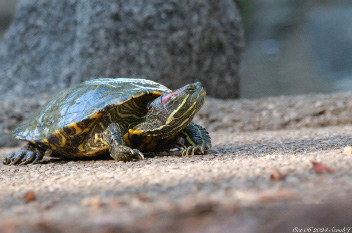
A red-eared slider making slow and steady moves towards you. (Credit: Jieyu Zheng)
Finally, a column about the turtles! The turtles have been an integral part of the Caltech community, and much of this connection is made by the enthusiastic Caltech students themselves. This column collects information and legends about the turtles from Hannah Way, the current president of the Caltech Turtle Club. Through my interview with Hannah, I learned many surprising and fun facts about Caltech turtles. I hope you, the readers, will learn something new from this article as well.
The Caltech pond ecosystems (see the previous issue on this topic) now host roughly 130 turtles at their maximum carrying capacity. However, just a few decades ago, the ponds had very different residents. After the 1971 earthquake destroyed the former Throop Hall, the turtle pond, formally part of the Throop Memorial Garden, was constructed in 1973. The ponds were originally meant to be regular koi ponds, much like the water systems you’d see in local gardens such as The Huntington Library or the LA Arboretum. Soon, the koi were replaced by crayfish, at one point by frogs, and only later did turtles begin to show up.
While a formal survey of the turtle population is still pending, it is safe to say that all the turtles in the Caltech ponds are pet releases or their descendants. The majority are red-eared sliders, the very turtles that inspired the iconic illustrations on the California Tech newspaper front pages. The “ethnic minorities” of the pond include one painted turtle, two razorback musk turtles, and two soft-shelled turtles named Pancake and Waffle. Sightings of these turtles are mysterious and unpredictable, and population counts have been pieced together solely through the spontaneous observations of various students – much like a criminal report assembled from collective evidence by many observant detectives. The Caltech Turtle Club has played a large role in this effort.
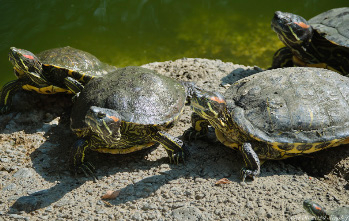
A cool sunbathing crowd on the shore of the pond. (Credit: Jieyu Zheng)
Like many fun and nerdy clubs at Caltech, the Caltech Turtle Club was founded by students with a pure love for reptiles. The club’s founder and current vice president, Rebecca Wipfler, along with President Hannah Way, are both graduate students in GPS. To spread their love for turtles, the club has run many educational programs for the public. These included a live stream of the turtle pond during Caltech Giving Day to share turtle joy with alumni, as well as outreach booths to answer questions from anyone strolling by the pond. Despite a modest annual budget of only $200, the club managed to connect with the Tortoise Conservancy and the LA Natural History Museum to organize visits and outings for deeper learning about these reptiles.
“We would definitely benefit from a larger budget,” said President Hannah, already planning more events for the currently brumating club (brumation being the turtle equivalent of hibernation). The club has been fundraising by selling specially designed turtle shirts — an example can be seen in the photo of Vice President Rebecca next to this column. I’ve spotted this lovely shade of green around campus – in the gym, at the cafeteria, and in classes. This is a symbol of the persistent love Caltech students share for these reptiles.
This love for turtles runs so deep that more than 600 students have signed a campaign to replace the Caltech mascot with turtles. While North American beavers are nowhere to be found in dry and sunny Southern California, turtles are far better everyday companions for students. Legend has it that stressed-out undergraduates will “claim” a turtle during the term as an emotional support animal, only to release it back to the pond at the end of the quarter before leaving for winter break. (Removing animals from the pond is not encouraged.) Clearly, turtles carry considerable weight in the hearts of Caltech students.
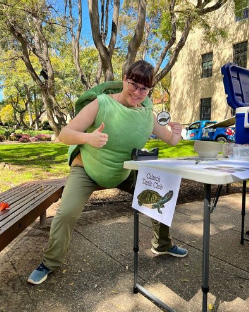
Caltech Turtle Club President Hannah Way in her uniform at the club outreach event. (Credit: Hannah Way)
Rest assured, the turtles are well taken care of. A balanced pellet diet is provided daily by Caltech Facilities. According to Hannah, the pellets are placed on the pavement so turtles can carry their food back into the water, where they can moisten and enjoy it at leisure. Dumping human food into the pond, however, is unsafe. While turtles may attempt to eat anything, uneaten food sinks to the bottom and degrades water quality. To keep the turtles healthy, it’s best to refrain from feeding them.
The Turtle Club also offers guidance on how to interact with these beloved residents. If you see a turtle strolling in the middle of the road, it is usually fine on its own—even if it looks slow and clueless to human eyes. In springtime, female turtles often leave the pond to lay eggs, and it’s best not to disturb them. Touching turtles with bare hands can transmit bacteria such as salmonella to humans, not to mention risking a turtle bite. Their beaks are powerful clamps, capable of breaking down food—and any perceived threats. If you do encounter a turtle in a roadway and are concerned, you can always call Caltech Facilities for assistance.
Whether as candidate mascot, myth, or legendary emotional support animal, the turtles remain a constant presence on campus – unbothered, sun-bathing, and very much at home at Caltech.
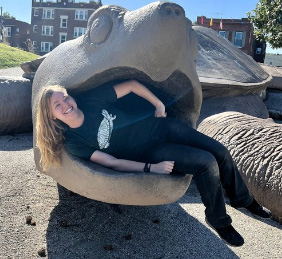
Vice President and Founder Rebecca Wipfler in the iconic turtle T-shirt. (Credit: Rebecca Wipfler)