
For Parker
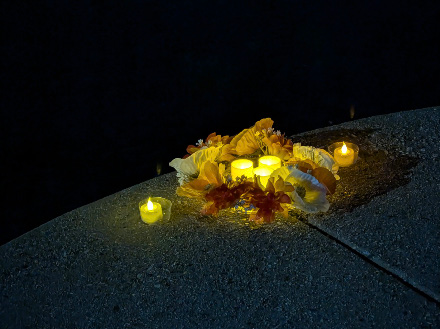
From Parker’s candlelight vigil. (Photo: Iris A. Lubashev)
yours is the death that cheapens all words and as i write this i scan each one not for beauty but for adequacy not for music but for weight i test them in the mouth of the sentence i press them against the fact of you gone and each one gives slightly under pressure as if language were made of softer materials than we had been told as if it were built for description but not subtraction as if it were designed for continuation and not interruption and this is not an English problem though English has its evasions its polite evasions we say loss as though something were misplaced we say passed away as though you stepped briefly into another room we say nineteen and expect it to hold still obedient to arithmetic but the number will not stay in its place it trembles under its own counting because numbers are supposed to add and what has happened here does not add it removes and it removes without ceremony and still the verbs conjugate still the calendar advances still the dining hall opens still the workshop door swings inward and the room arranges itself as though nothing essential has shifted which feels like a kind of cruelty not that language fails but that it continues functioning perfectly well in your absence
you loved craft how a line could move like water how description could bend toward science without surrendering music how revision was not embarrassment but belief that the thing could be made more exact and i want that to be true here i want revision to be possible beyond the page i want to revise the world back to the version where you walk into the workshop and the air adjusts imperceptibly but undeniably where conversation becomes permission where someone else feels brave because you did where thought expands because you were there to hold it steady but revision requires a draft and this is not a draft this is the final copy and finality is the one thing language pretends not to understand
particularity resists summary you were not promise not potential not radiance though you were radiant you were the slight pause before speaking as if making room for someone else’s thought you were the way someone could read a room and a poem at once you were the almost invisible generosity that altered the temperature of a space and there is no collective noun for that there is no grammatical tense for that there is no construction that returns it once removed
this is not an English problem it is the fact that language was built for construction it assumes tomorrow it leans forward by habit
and yet here we are still writing