
The Friendships That Introduced European Modernism to California
In 1915, Emilie Esther Scheyer came across The Hunchback (1911) by artist Alexei Jawlensky in Lausanne, Switzerland. The painting was so impactful that she was determined to meet Jawlensky, setting the course for her life and career, as well as the development of modern art in California.
Dear Little Friend: Impressions of Galka Scheyer opened at the Norton Simon Museum last month. Organized by Curator Gloria Williams Sander, the exhibition focuses on Scheyer’s relationships with artists and supporters that enabled her work in promoting European modernism, particularly the Blue Four: Lyonel Feininger, Alexei Jawlensky, Paul Klee, and Vassily Kandinsky.
Born in Braunschweig, Germany in 1889, Scheyer was the youngest of three children who didn’t end up working in the family’s canning business. After studying art across Europe, including at the École des Beaux-Arts in Paris, Scheyer was working as a painter on the pivotal day she saw The Hunchback. After meeting Jawlensky, she became his friend and agent, and by 1919 had ended her painting career.
“Why should I go on painting when I know I can’t produce such good art as you?” she asked him. “It’s better to dedicate myself to your art and explain it to others.” Jawlensky gave her the nickname “Galka,” which is Russian for the highly intelligent jackdaw bird.
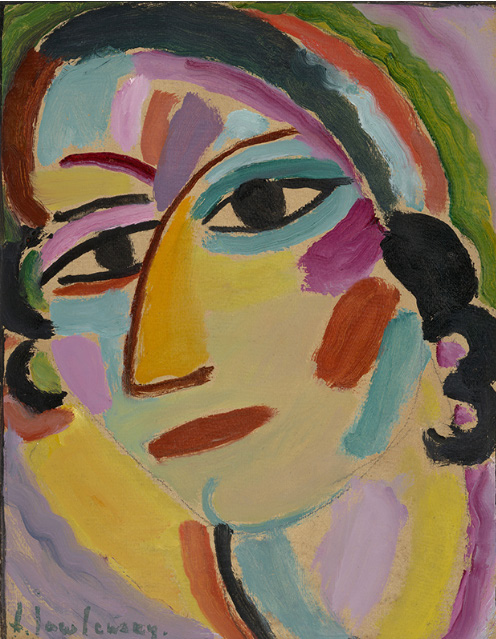
Alexei Jawlensky, Mystical Head: Galka, 1917. (Photo: Norton Simon)
After successfully showing Jawlensky’s work across Germany and building a wide network in the German and European avant-garde, Scheyer brought him together with three other artists: Paul Klee, Lyonel Feininger, and Vassily Kandinsky. This group “was more a matter of economics than aesthetics,” according to the Los Angeles Times. The three men were instructors at the Bauhaus, an influential German school of art, design, and architecture that was forced to close in 1933 amid Nazi attacks on modernism and charges of Bolshevism.
Scheyer coined the term “Blue Four” for the four artists and became their American legal representative in 1924, moving to New York City to promote their work and ideas. After a disappointing year, she relocated to Northern California and made important friends, such as director William H. Clapp of the Oakland Art Museum, photojournalist Dorothea Lange, and artists Edward Weston, Diego Rivera, and Frida Kahlo.
In 1930, she settled in Los Angeles to capitalize on her network and prospective Hollywood clientele, expanding her circle to include collectors Walter and Louise Arensberg, Academy Award-nominated director Josef von Sternberg, and many German émigré artists. Scheyer commissioned prominent modernist architect Richard Neutra to design her Hollywood Hills house, which was planned specifically to display art.
During her 20 years in California, Scheyer promoted the Blue Four through numerous exhibitions and lectures, including events at her house even before construction was complete. Her work as a dealer, educator, and curator advanced the early modern art scene in California.

“Prophetess of the Blue Four,” The San Francisco Examiner, Nov. 1, 1925. A profile of Scheyer and her promotion of the Blue Four. (Image: The San Francisco Examiner)
“Scheyer impressed artists and collectors and even critics who were weary, if not outright hostile to European modernism at this moment in time,” Curator Sander stated for the Norton Simon Museum’s 2017 exhibition on Scheyer, Maven of Modernism: Galka Scheyer in California. “For California artists, exposure to the Blue Four and the European art in her collection introduced revolutionary new ideas. It provoked them to think critically about their own practice, and Scheyer was a willing participant in those conversations.”
“Dear Little Friend” presents a layered view of Scheyer’s career, emphasizing the close relationships that shaped her legacy. The focused exhibition brings together portraits and archival material, including gifts she received from the Blue Four, to highlight her work in promoting them.
After becoming ill in 1944, Scheyer arranged for her personal collection to go to UCLA, where it was intended to join the Arensberg collection as the foundation of a new university museum. That plan never materialized, and in 1953 her substantial and distinguished collection of some 450 works was given instead to the Pasadena Art Institute (now the Norton Simon Museum).
The exhibition, which runs until July 20, includes art from Scheyer’s collection by artists such as Beatrice Wood and Edward Weston. Its title, Dear Little Friend, comes from how Feininger of the Blue Four addressed Scheyer in letters, reflecting the close relationships that shaped her work.