
Artemis II and the Return Beyond Earth Orbit
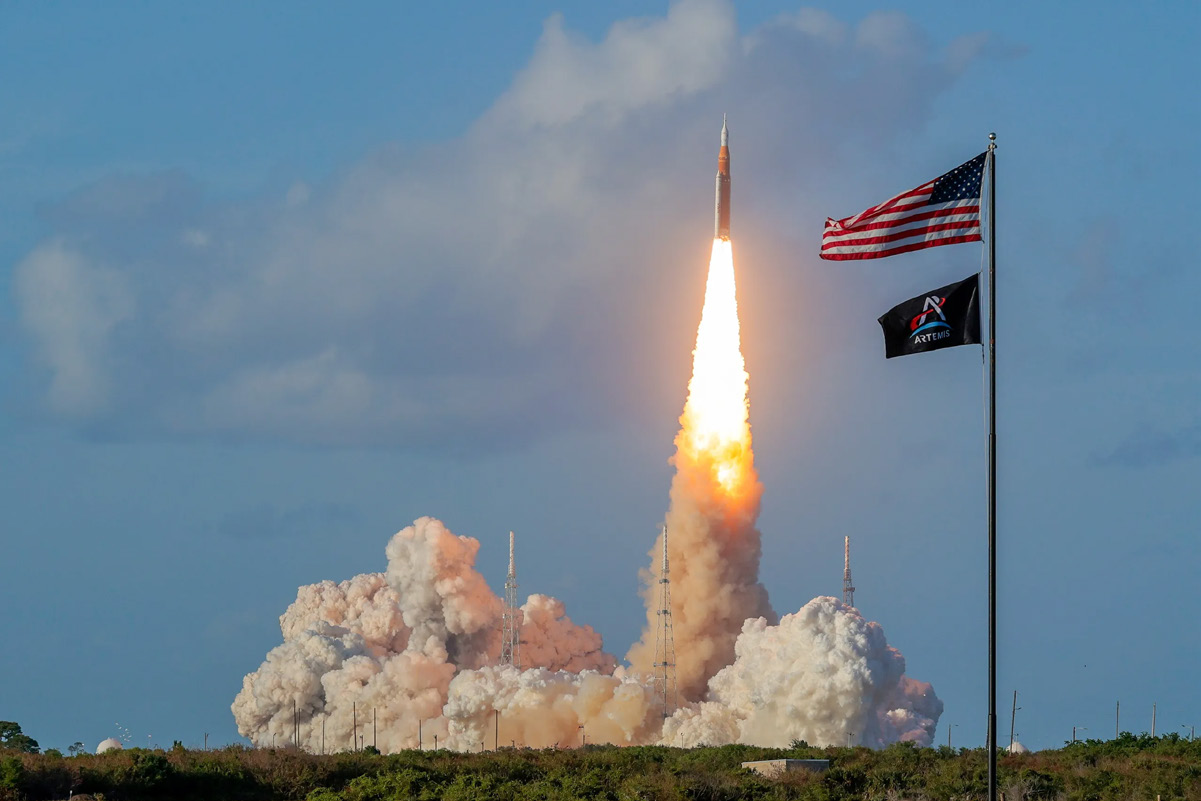
NASA’s Artemis II Space Launch System lifted off from the Kennedy Space Center in Cape Canaveral, Florida on Wednesday, April 1. (Photo: Chip Somodevilla/Getty Images)
Just days after liftoff from Kennedy Space Center at 6:35 p.m. EDT on April 1, Artemis II has reestablished a capability absent since Apollo 17: human transit beyond Earth orbit. The mission represents the first crewed validation of a modern deep-space system and marks a transition from experimental demonstration to operational architecture for lunar exploration.
The key maneuver occurred during the translunar injection burn, a roughly six-minute firing of the Orion service module engine. This burn raised the spacecraft’s energy above Earth escape, placing it on a free-return trajectory toward the Moon. With this event, astronauts Reid Wiseman, Victor Glover, Christina Koch, and Jeremy Hansen became the first crew in over 50 years to enter cislunar space. At time of writing, the capsule is over 150,000 miles from Earth, approaching the midpoint of its outbound trajectory.
From an engineering standpoint, Artemis II is a full-system test of NASA’s Space Launch System and Orion under crewed conditions. Early mission phases included insertion into elliptical and high Earth orbits, separation from the interim cryogenic propulsion stage, and a manual piloting demonstration using that stage as a target. These operations validate guidance, navigation, and control performance, as well as crew interfaces and handling characteristics. Subsequent transitions to the Deep Space Network and activation of redundant subsystems extend this validation into the deep-space environment.
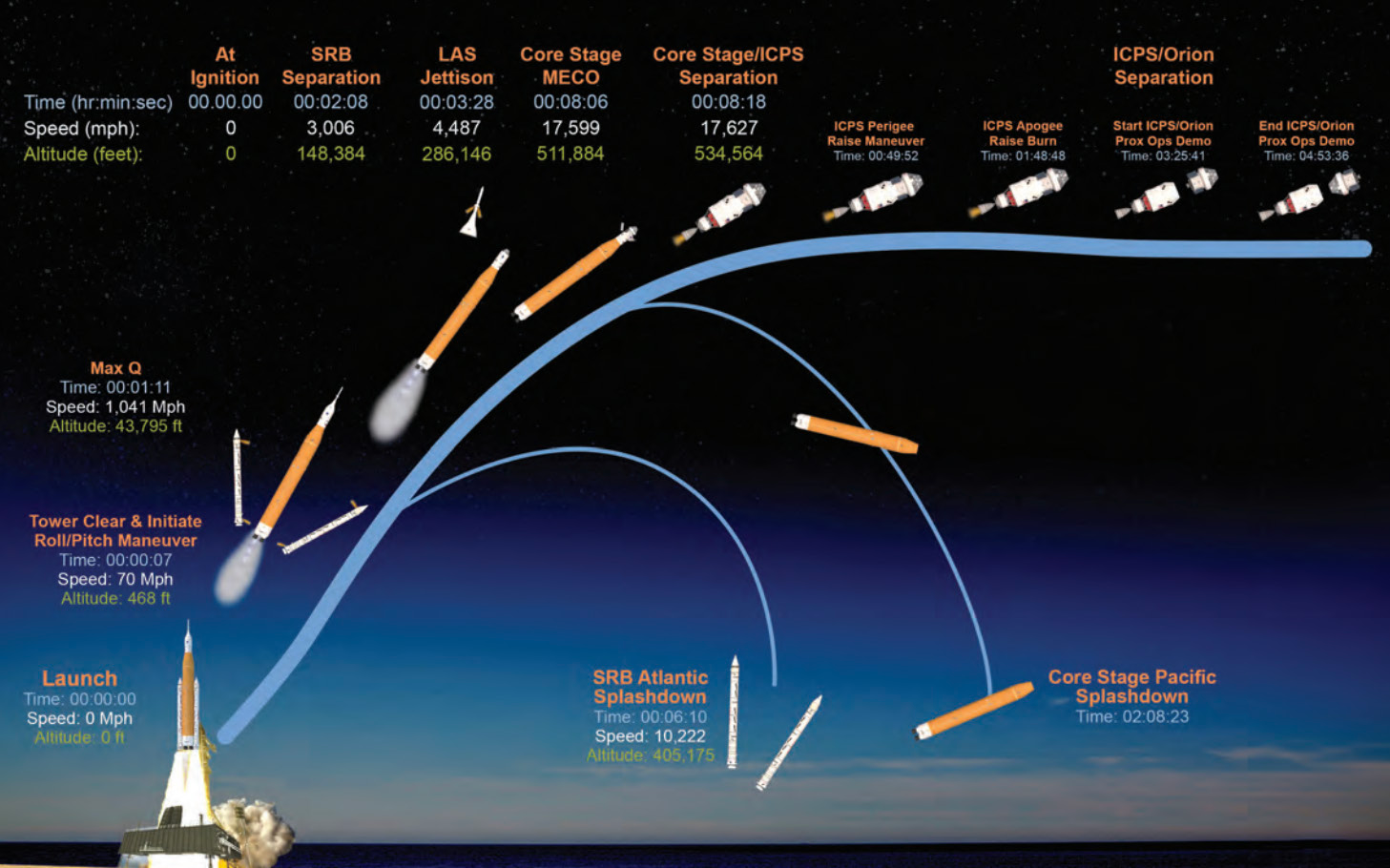
Artemis II launch sequence from mission documentation, showing solid rocket booster (SRB) jettison, followed by separation of the core stage and launch vehicle stage adapter. The Interim Cryogenic Propulsion Stage (ICPS) and Orion stage adapter then separate from Orion, after which CubeSat payloads are deployed. (Image: Space Launch System/NASA)
Mission objectives emphasize system reliability and operational readiness. These include sustaining crew health and performance, exercising contingency procedures, and collecting telemetry across propulsion, thermal control, life support, and communications systems. Even minor anomalies, such as early issues with onboard sanitation systems, provide useful data for refining hardware and procedures ahead of longer-duration missions.
The mission also contributes to observational science and public engagement. High-resolution imagery returned by the crew shows Earth at large phase angles, including views of the atmospheric limb, auroral activity, and the day-night terminator. These datasets complement existing Earth observation records and demonstrate the capabilities of crew-operated imaging in deep space.
Artemis II’s planned lunar flyby on April 6 will provide additional observational opportunities. The spacecraft will pass around the Moon’s far side, a region not directly viewed by humans since the Apollo era. Partial illumination conditions are expected to enhance topographic contrast, aiding visual identification of surface features relevant to future exploration.
Within the broader context of spaceflight history, Artemis II functions as a systems-level verification step for sustained lunar operations. Unlike Apollo, which demonstrated feasibility, the Artemis program is structured around repeatability and scalability. Data returned from this mission will inform subsequent flights, including crewed lunar landings and extended surface operations. In this sense, Artemis II is less a singular milestone than a critical validation phase in the development of an extended human presence beyond low Earth orbit.

“Hello, World,” an image of Earth taken from the Orion capsule on April 2. (Photo: Reid Wiseman/NASA)