
Our Trip to D.C. — The Life Cycle of the Scientific Idea
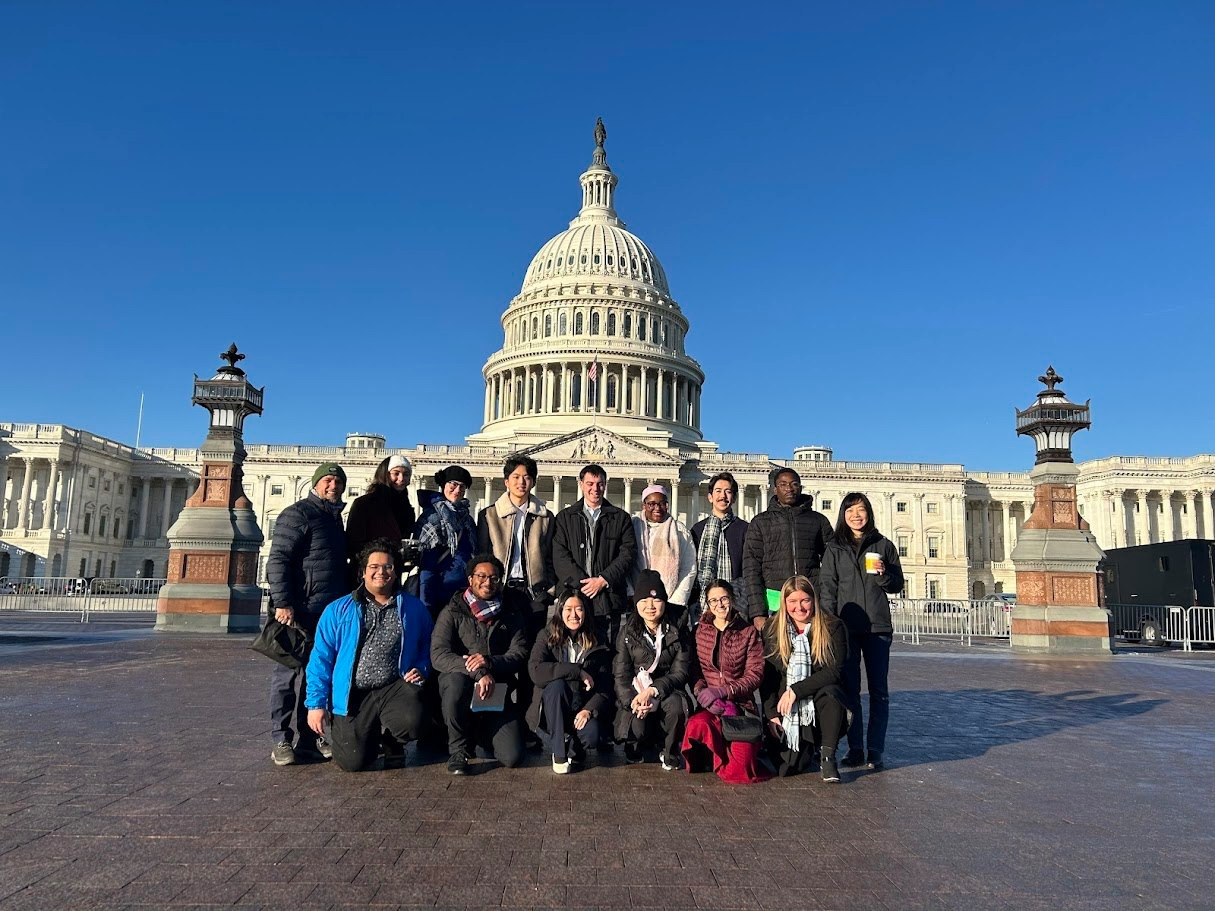
The group in front of the Capitol.
This article was written by members of Science and Engineering Policy at Caltech (SEPAC).
Right now, most of us are tunnel-visioned on solving a frontier scientific problem. However, the moment you glance up from your microscope, algorithm, or chalkboard, you realize that this myopic luxury is sustained by a delicate flow of federal funding, agency agendas, and perpetual grant writing. We call this hidden backbone of modern science “the lifecycle of a scientific idea.”
In late 2025, the threads of this lifecycle stretched close to snapping, as many of us felt the impact of cuts to federal agencies, reductions in NSF student grants, and the Trump administration’s attacks on U.S. academic institutions. Shocked, but eager to understand this disruption, 13 graduate and undergraduate students took to Washington, D.C. in December. What follows is an account drawn from reflections on our whistle-stop tour of meetings on Capitol Hill, in the White House, and with lobbyists and agency officials. We hope to show you that, no matter how much of a scientific purist you are, the lifecycle of everyone’s work can come under scrutiny — and to help you stay informed when it does.
As researchers, we often imagine that scientific ideas spend most of their lives near us. In reality, we see only a small slice. The process begins at the top: The president proposes a budget, informed by the Office of Science and Technology Policy (OSTP) and external advisors such as the President’s Council of Advisors on Science and Technology (PCAST). That proposal goes to Congress, which holds hearings, revises priorities, and ultimately allocates funding to agencies like the NSF and NIH. The budget then returns to the president for approval. If enacted, agencies distribute funds through grants, overseen by the Office of Management and Budget (OMB). Finally, researchers (like you and your PIs!) write proposals to secure funding and carry ideas forward — at least in the ideal case.
In reality, the links between these steps are fragile. Misalignment between branches of government, agencies, and public priorities can lead to delays, cuts, and inefficiencies that affect everyone touched by science — which is to say, everyone!
Last year, these cracks became more apparent as growing distrust between the scientific community and the federal government began to reshape funding priorities. In response, a group of 13 graduate and undergraduate students — each with their own motivations — joined the Caltech Y’s Science Policy trip to D.C.
Some sought to understand how a system long assumed to be stable could falter. Maria, a fifth-year Ph.D. student in biophysics, reflected: “Federal science funding seemed stable … but when the administration changed in January 2025, I became painfully aware of the fragility of a system I had taken for granted.”
Others were alarmed by the deprioritization of research areas such as climate science and the erosion of international collaboration. Myles, a fifth-year Ph.D. student in astronomy, noted that recent policies “contradict decades of research” and have already disrupted work at major universities, pointing to cuts in climate funding, the $100,000 increase in H-1B skilled worker visa fees for international researchers, and resulting layoffs of graduate researchers. He added that such policies not only hinder essential environmental science — critical in places like California for understanding and mitigating wildfires — but also “actively damage connections to local communities.”
For many, frustration turned into motivation. ChiChi, a third-year undergraduate in applied and computational mathematics, expressed her post-graduation operations as either “a) making a billionaire richer while working in an industry lab,” or “b) having the impact of my work only understood by a select group of experts while working in academia.” She joined the trip to explore paths that could “make tangible, real-world impacts that can be realized by everyday people, especially those in the diverse communities I hail from.”
Zoe, a third-year Ph.D. student in chemistry, reconsidered her own trajectory after losing funding for her research in atmospheric chemistry. “I’ve always been drawn to policy, to making a difference,” she said. “I thought studying sustainability and working in science would do that, but after my funding was cut … I realized there’s so much more that affects what science gets done and how it affects the public, far beyond the researchers.” She added that this realization pushed her to consider “bridg[ing] the intersection between scientists and policymakers,” though she was still seeking how best to do so.
Together, this diverse coalition set out for D.C., where we met actors across the scientific lifecycle: OSTP staff, OMB analysts, DARPA researchers, FDA regulators, congressional aides, and science lobbyists. We also observed legislative proceedings firsthand from the House gallery.
In conversations with scientific actors, we gained some insight into how decisions are made — but often left with more questions than answers. Our attempts to understand the roots of miscommunication between scientists and the U.S. government, and to identify paths for meaningful change, were largely unmet.
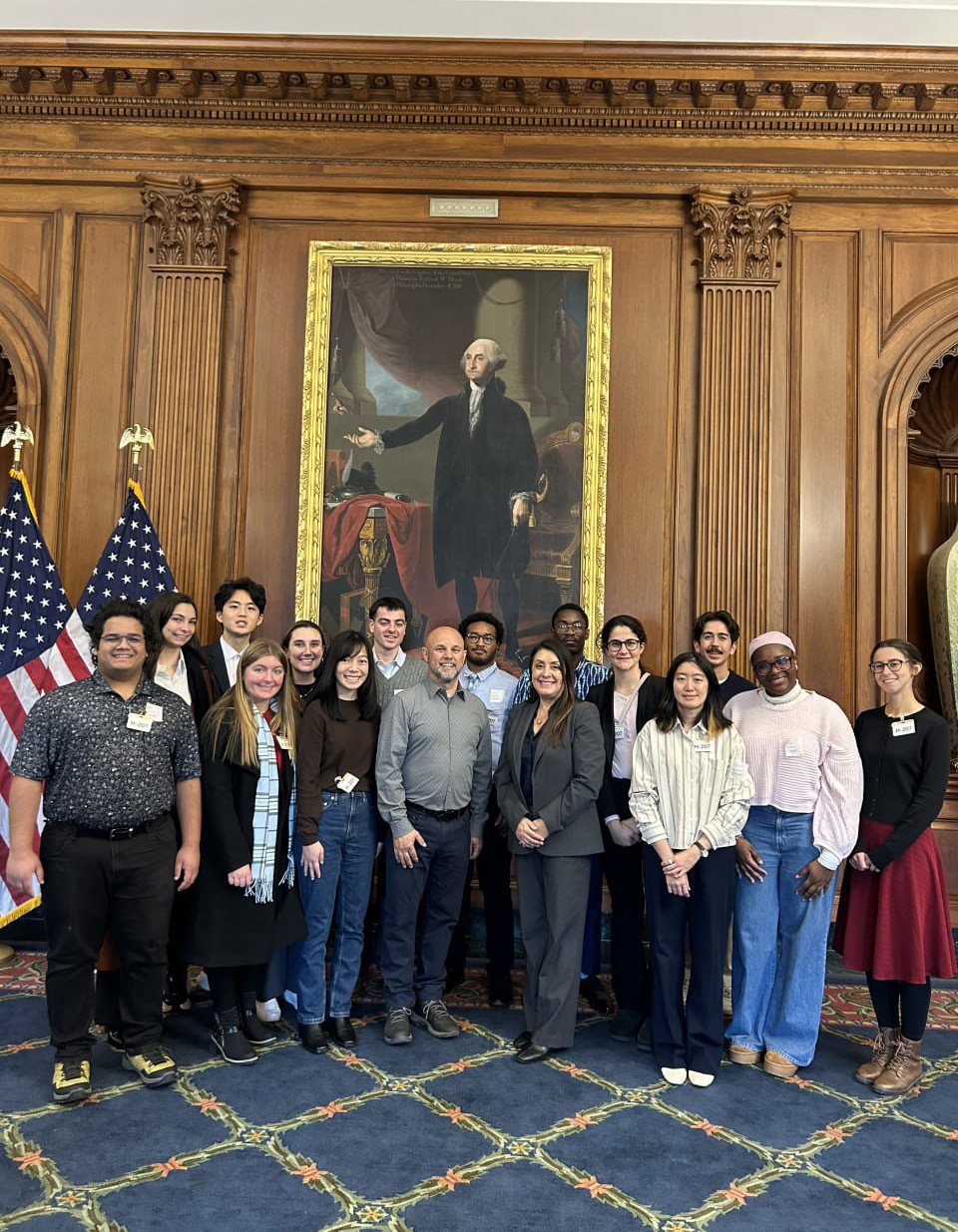
The group with Rep. Luz Rivas.
Through meetings with an OMB analyst and congressional staffers, we learned that while they gather evidence to inform decision-makers, they often filter it to fit party platforms. Scientific ideals, it seemed, come second to political agendas set by non-scientists. Even when speaking with the advisors at the seemingly highest level, where lead scientists guide the president on scientific priorities, we researchers felt unrepresented. At the OSTP, discussions “continued to prioritize national security without acknowledging that the best science comes from diversity of thought,” reflected Myles.
In the same conversation on the White House grounds, the OSTP emphasized working towards an ideal “meritocracy” by excluding social considerations, “neglecting the resource and opportunity disparities that persist in our society,” leaving “no room for evidence-based research, science results, or critical discourse in the government.” Time and again, our conversations with executive branch actors, even where priorities are set, emphasized political leverage over scientific reasoning.
We also witnessed this dynamic firsthand on the House floor, where members debated a healthcare bill largely by reciting prepared statements — before a chamber that was practically empty! From the White House to Congress, that is, from the top down, advisors and policymakers often fell back on political agendas rather than engaging in genuine, reasoned dialogue. This, we felt, is where the dysfunction lies.
Initially, these experiences left our group deflated. Many of us felt uncertain and disoriented — until, on our final night, we did what political parties seemingly can’t: talk to each other. In doing so, we shared our dismay but — more importantly — realized some key takeaways from our trip that gave us hope.
The reality is, while the scientific lifecycle is clearly strained, it remains the system within which we must operate. In the words of one of our undergraduates: “Science is a powerful tool for innovation and development, but science policy is one of the structures that determines who ultimately benefits from that power.”
As scientists, we hope for a direct line to policy that affects our work, yet science is often “filtered” before reaching decision-makers — through congressional staffers, data analysts, and political intermediaries. Across our conversations, Will, a third-year Ph.D. student in aerospace, noticed that “the uniting characteristic … was effective communication.” To ensure that critical science is prioritized, we must learn to communicate it in ways that resonate with policymakers and constituents — framing ideas so they align with legislative priorities.
At Caltech, we are trained to communicate with other scientists. But to have a broader impact, especially in Washington, we must also learn to “distill complex data into accessible, actionable insights for non-experts,” as a freshman undergraduate who attended realized. This realization brought us back to the question that motivated many of us to take the trip in the first place: How can scientists make an impact?
Over the course of the trip, our answers shifted. Work in Washington is one avenue for change — but not the only one. Amanda, a first-year Ph.D. student in mechanical engineering, reflected that “the framework on the Hill wasn’t where I’d be most effective.” Instead, she saw impact emerging at the individual level: engaging with local governments, making science accessible to her community, and fostering conversations rooted in understanding.
Across the group, one conclusion was clear: scientists have a responsibility to be civically engaged. As an undergraduate trip-leader put it, “every scientist should be politically aware … so they know how their science is being affected and how their science may affect other people.” The journey of scientific ideas through political systems showed us that “it is no longer enough to produce excellent research”; there is also a “responsibility to ensure that research is translated, advocated for, and integrated into policies that address our most pressing global challenges.”
The sweeping actions toward science taken by the current administration over the past year are atypical but, unfortunately, will have lasting consequences. An FDA scientist told us it has been “hard to recruit and rehire scientists due to uncertainty after mass layoffs.” Representative Luz Rivas warned that “Trump’s detrimental acts on science could take a generation to repair.” Science, however, is fundamentally bipartisan, and its benefits are universal. It is our responsibility to ensure that it can continue.
Returning to Caltech with a renewed sense of civic responsibility, our group decided to revive an organization from several years ago: Science and Engineering Policy at Caltech (SEPAC).
In its prime, SEPAC led campus discussions about science policy and invited speakers to engage the student body on policy issues. Over time, the club faded.
Returning from D.C. with a renewed commitment to scientific advocacy, our group revived this organization with a new, threefold mission:
- Inspire the Caltech community to participate in informed science policy discussions (and consider the broader context of their work).
- Educate the community about science communication, policy, and advocacy.
- Facilitate opportunities to engage with policy stakeholders and take action.
By sharing what we learned on our trip, we take our first step as an organization: hoping to inspire you to do the same. Now is the time to act.
Moving forward, we plan to host educational meetings on scientific communication and poster sessions with local officials to help contextualize Caltech’s research for a policy audience.
To learn more or get involved, visit sepac.caltech.edu, email sepac@caltech.edu, or join us at our first event, where we’ll summarize our trip and involve other organizations to share opportunities in science policy.
Photos courtesy of the authors.