
ME 72’s “Apex Cleanup”: Caltech’s Ultimate Design Showdown
By the time the doors opened at Scott Brown Gym on March 10, the students of Caltech’s ME 72 capstone course had already spent months living inside the problem. For roughly 15 weeks, teams of mechanical and civil engineering undergraduates had designed, machined, wired, coded, tested, broken, repaired, and rebuilt robots for one public reckoning: the 41st Annual ME 72 Engineering Design Competition. When the machines finally rolled onto the floor, the question was no longer whether the ideas were clever. It was whether they would work under pressure.
If you have never heard of ME 72, that is a shame, because the course is one of Caltech’s most serious and revealing traditions. It is not an extracurricular showcase or a résumé ornament. It is the Institute’s mechanical engineering capstone: a two-term design sequence in which third- and fourth-year students are pushed through the entire engineering cycle, from concept development and analysis to fabrication, testing, integration, and competitive performance. As instructor Michael Mello put it, every mechanical engineering program needs a capstone; at Caltech, ME 72 is that final exam. It just happens to involve robots.
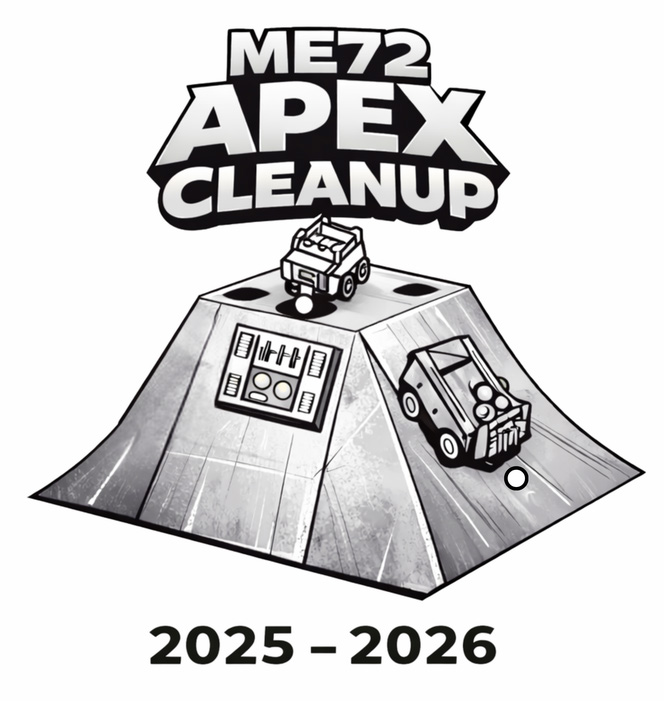
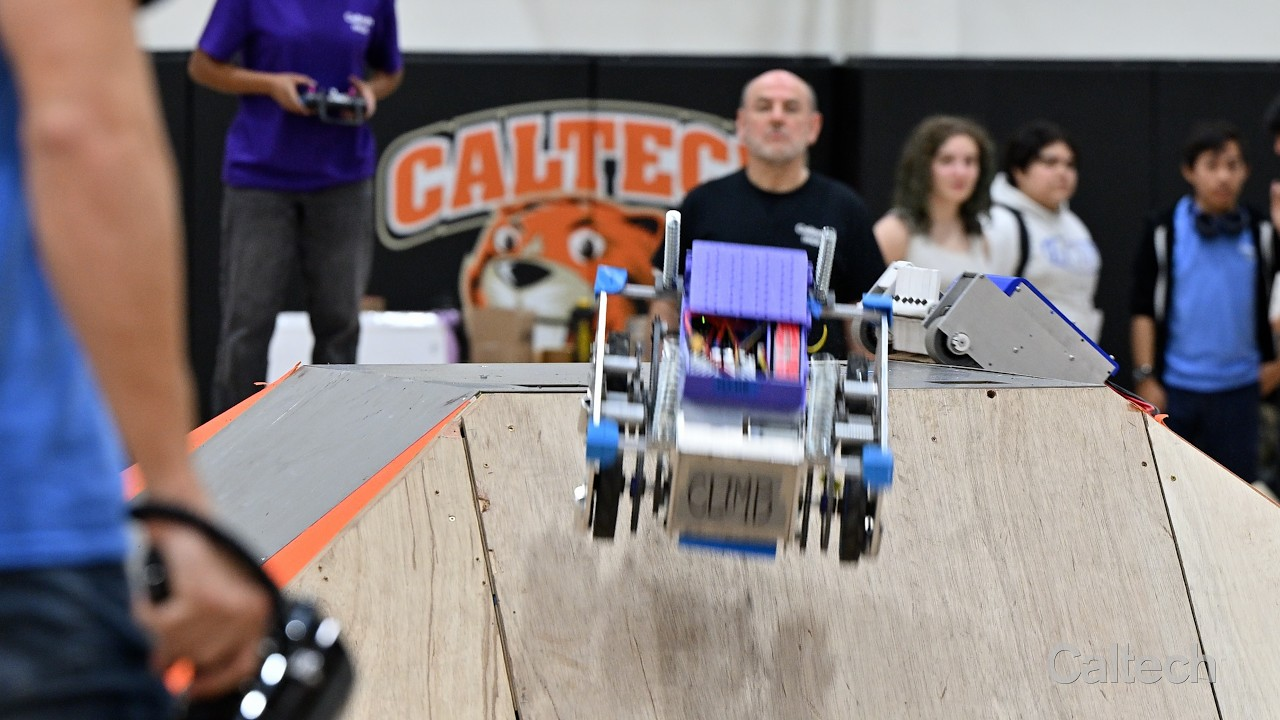
This year’s challenge, “Apex Cleanup: Summit, Mint, Bank,” centered on a steel-skinned pyramid planted at the center of a 40-foot-square field. The structure stood four feet tall, with faces pitched at 37 degrees and a narrow 3-by-3-foot summit deck at the top. Robots had to climb those inclined steel faces, crest the summit, and operate on the platform under competitive pressure from other teams doing the same. The pyramid was not just scenery; it defined the entire match.
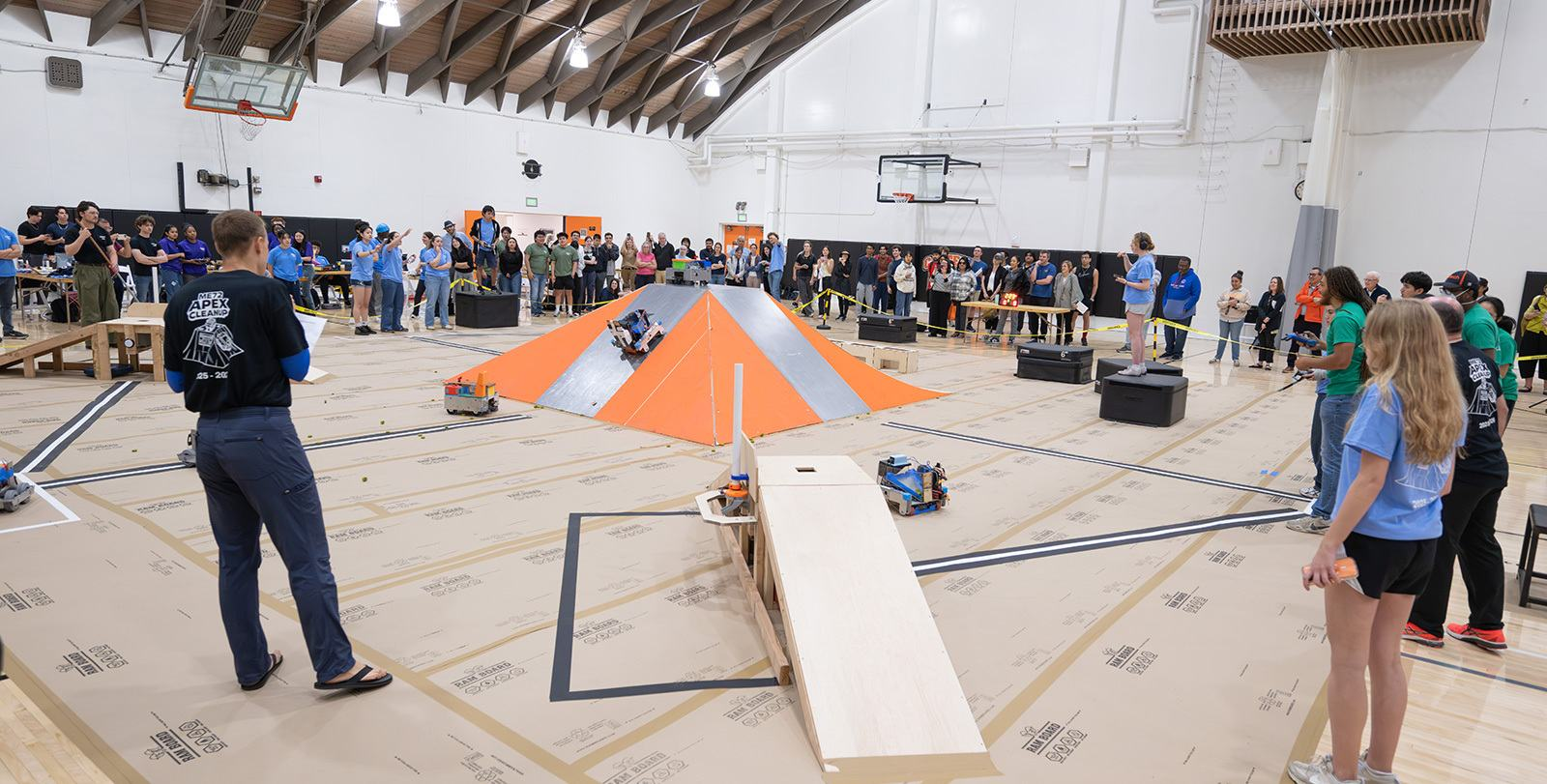
The game’s scoring system made the pyramid even more central. Teams collected Hot Pellets from the arena floor and transported them upward. Pellets deposited at the summit were converted into Energy Credits, which rolled back down toward floor-level Vaults, where they could be banked for points. Teams could also intercept those returning Energy Credits for bonus points, provided they banked them successfully. There was a lower-risk, lower-value ground route through Depot processing, but the summit offered the biggest rewards. In this game, the climb was where the points lived.
Each match lasted four minutes and thirty seconds and began with a 30-second autonomous period, during which robots operated on pre-programmed logic before the teleoperated phase began. Three teams competed in each face-off, and each team could field up to two robots at once, meaning the arena could fill with as many as six machines jostling for pellets, space, and position. The design challenge was not merely to build a robot that could climb once, but to create a system that could repeatedly ascend, crest, score, descend, survive contact, and do it all again under tournament conditions.
That made the engineering problem brutally honest. A 37-degree steel incline demanded traction, torque, stability, and disciplined geometry. Cresting the top required careful control and clearance management. Descending safely mattered almost as much as climbing. Meanwhile, field congestion and repeated physical interaction forced teams to consider durability, compact packaging, motor load, and systems integration. Students fabricated custom chassis and mechanisms using precision machining and additive manufacturing, then integrated motors, sensors, electronics, and embedded control systems into robots that had to function reliably in chaos.
The work took place largely in the Jim Hall Design and Prototyping Lab, in the subbasement of the Eudora Hull Spalding Laboratory of Engineering, under the supervision of co-instructor Paul Stovall and lab machining assistant Trent Wilson. Former ME 72 students returned as teaching assistants and peer mentors, while current teams put in late nights refining mechanisms and troubleshooting integration failures. By competition morning, the gym was already alive with the whir of motors, the clatter of tools, and the quick, anxious glances of teams watching their rivals test movement across the field.
Six teams lined up for this year’s contest, each with a name that sounded less like a class project and more like either a rock band or a cry for help. There was Big Red — Joshua Braun, Alexander Crowley, Ethan Hamel, Axel Haydt, Raymond Provost, Alexi Stapf, and Marissa Till — a team name that suggests confidence, menace, or possibly both, and the representation of Fleming house. The Clanks — Kevin Chung, Jorge Elias, Brandon Franco, Carlos Olivas, and Alexis Zuniga Diaz — at least had the honesty to brand themselves with the sound every mechanical engineer fears hearing at the wrong moment. Pharaobots — Sophia-Marie Andrews, Miina Anvelt, Daniel Brito Matehuala, Wenshao Dong, Ana Jaramillo, Anya Mischel, and Hannah Ramsperger — committed fully to the pyramid bit and, as it turned out, had the performance to back up the theme. Pyramaniacs — Susanna Cao, Noah Howell, Mahak Mathur, Logan Smith-Perkins, and Eloise Zeng — sounded exactly like a team that had stared at a steel slope for long enough to start loving it. Climb & Punishment — Diya Agarwal, Citli Carrera Arenas, Renee Hsu, Angelica Moussabote, Miigwan Tanner-Wostrel, and Jordan Threat — may have had the most accurate title of the day. And then there was MechE Wednesday: After Party — Elise Chu, Aiden Di Carlo, Jason Kamau, Maryan Malkosh, Ried Nussbaum, Deon Petrizzo, and Ethan Pichon — whose name promised either victory, collapse, or a very memorable evening and drinks. Together, they were less a set of student teams than six highly caffeinated design philosophies on wheels.
The tournament unfolded as a ten-match round robin, with teams forced not only to perform but to endure. Before the competition, milestone tests had already required teams to prove single capabilities such as climbing and pellet intake. Match play was another matter. Robots sometimes had to compete in back-to-back rounds, accumulating wear and damage. Between matches, students crowded the sidelines, repairing drivetrains, adjusting mechanisms, and improvising fixes as the day accelerated. If resilience was not the official theme of ME 72, it became the unmistakable one.
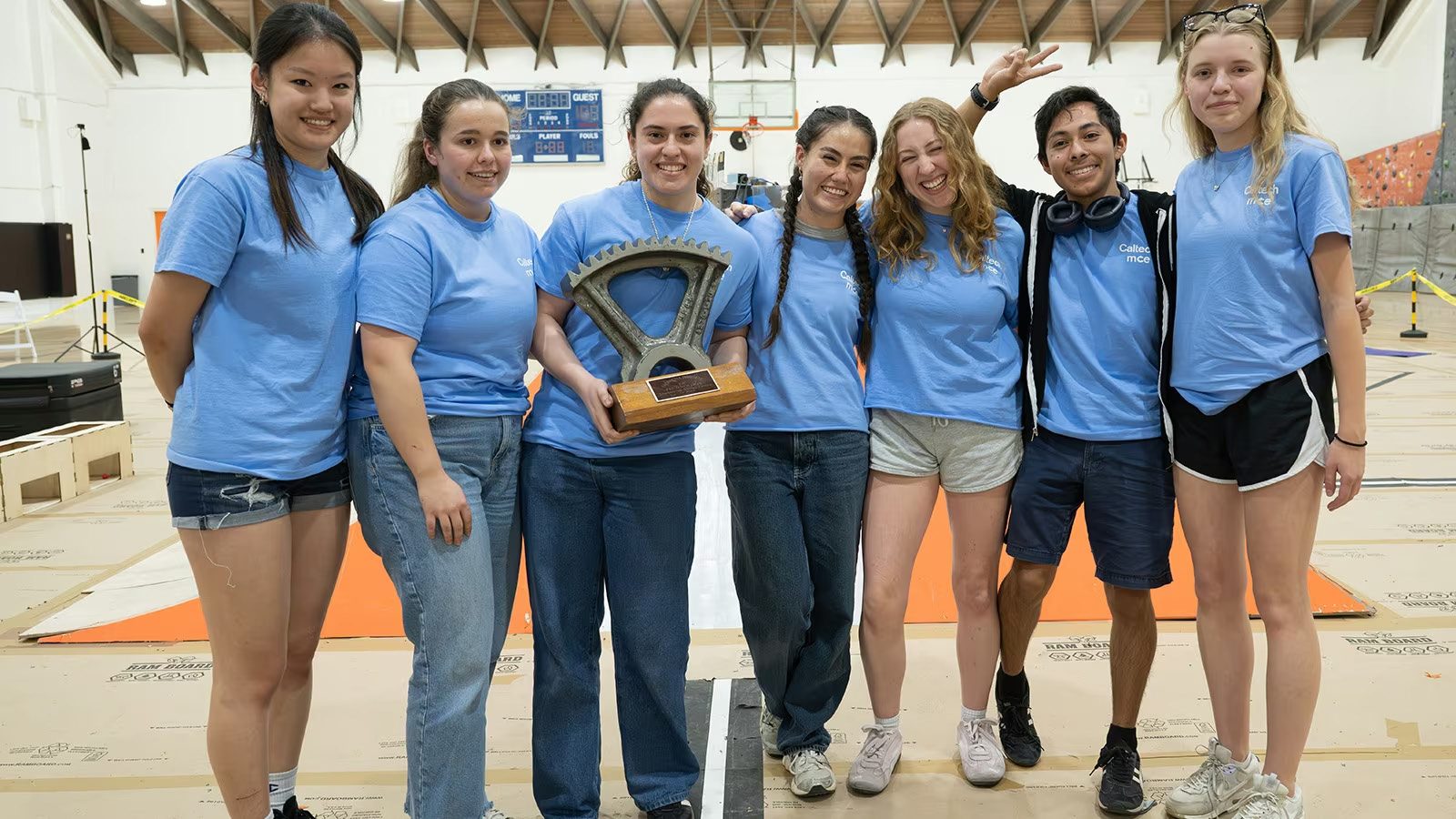
By the end of the opening round, four teams had advanced to the semifinals: The Clanks, Pyramaniacs, MechE Wednesday, After Party, and Pharaobots. Pharaobots quickly emerged as one of the field’s most consistent teams. According to Caltech’s competition coverage, the team had spoken openly beforehand about nerves, but once the matches began, their robots climbed reliably and scored across successive rounds. In the final, Pharaobots defeated Pyramaniacs to claim the win and lift the long-standing gear-shaped ME 72 trophy.
What the public saw in Brown Gym was spectacle: steel, collisions, climbs, summit deposits, repairs made in a panic. What the students experienced was something more lasting. Ana Jaramillo of Pharaobots said after the event that she had expected the competition to be fun, but found this year’s challenge especially rewarding because it was “more abstract, different, and challenging” than previous editions she had seen. Her teammate Anya Mischel described the team’s biggest struggle as integration: individual subsystems worked on their own, but getting everything to function smoothly together was another matter entirely. After the win, she reflected that the team had made “almost every possible mistake throughout the process,” and learned from each of them.
That, more than the trophy, is what ME 72 appears designed to teach. Mello called the course “a wonderful proxy for industry experience,” because it forces students to work through the realities that define engineering outside the classroom: communication, miscommunication, compromise, responsibility, deadlines, and the stubborn fact that no design is proven until it performs in the real world. In Brown Gym, that lesson played out in plain view. By the end of the day, one team left with the trophy. All of them left with something harder to measure and, in the long run, probably more important.
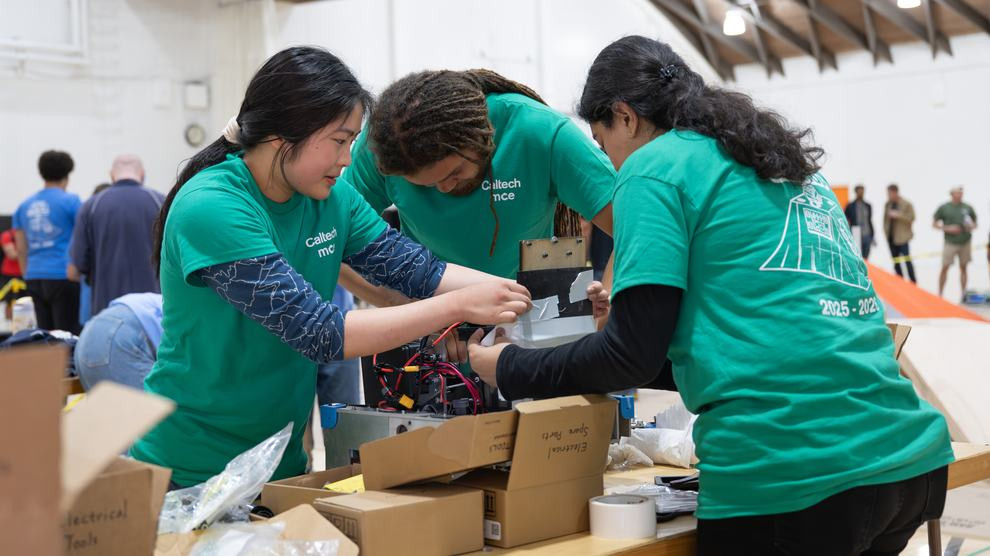
Photo coverage from the event, including match action, robot repairs, and the Pharaobots’ trophy celebration, appears in Caltech’s official competition story. (Photos: Lance Hayashida/Caltech)