
Nature Astronomy Study Demonstrates Feasibility of Orbiting Starshade for Ground-Based Exoplanet Imaging
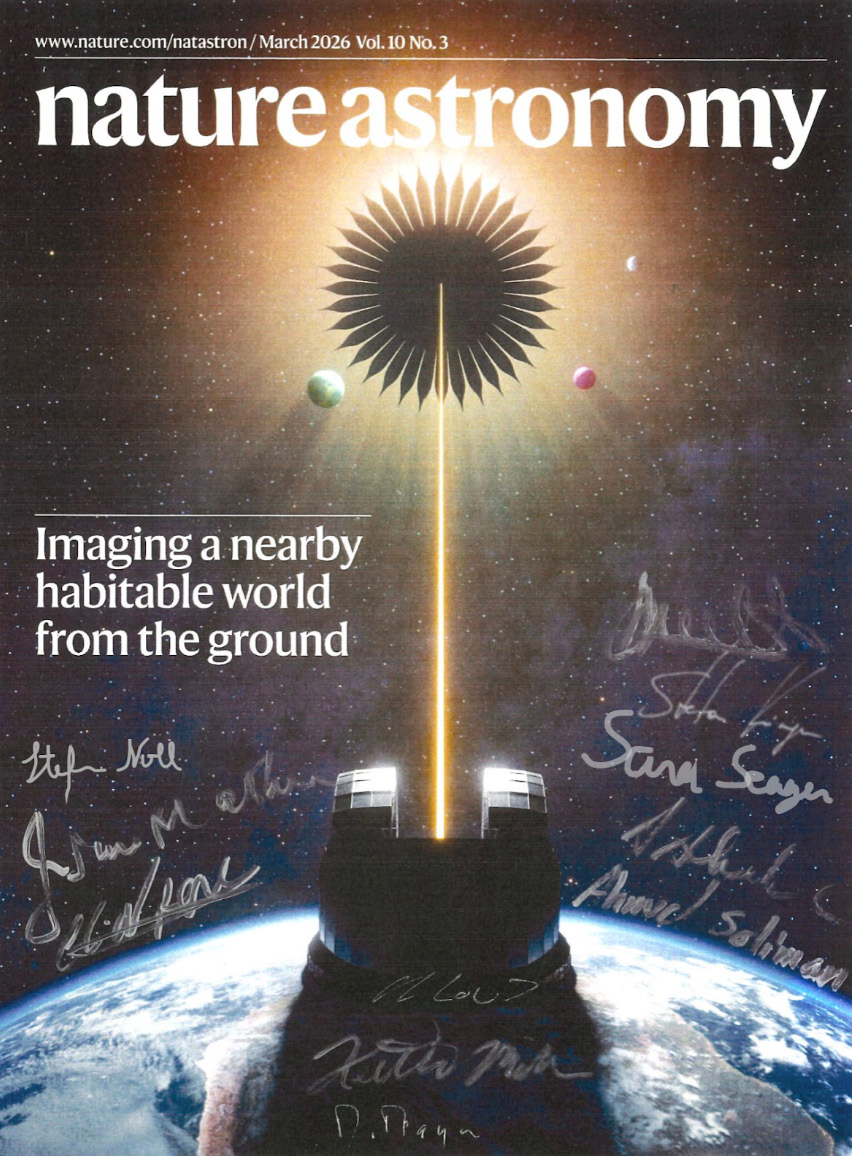
The Nature Astronomy cover image was signed by all authors, including Caltech KISS Harriet Brettle and Caltech-IPAC Kieth Miller. Credit to Soliman, A., Mather, J., Shaklan, S. Peretz, E. et al. “The observation of Earth-like exoplanets with ground-based telescopes and a shared orbiting starshade.” Nat Astron 10 349–356 (2026). Cover design by Bethany Vukomanovic. (Image: KISS/Keith Miller)
Continuing what we discussed in the previous article (“Can we detect an Earth-like-Exoplanet orbiting a Sun-like-Star for signs of life?,” The California Tech, November 12, 2024), we have published a new study in Nature Astronomy and was selected for the March cover issue of that journal. This study demonstrates the feasibility of directly imaging a Solar System analogue around a nearby star by deploying a space-based starshade in orbit at 170,000 km, to produce an almost perfect shadow across the apertures of Earth’s largest large ground-based telescopes currently under construction. This published paper combines wonderful authors from all over the world, including the 2006 Nobel Laureate John Mather and the 2019 Nobel Laureate Michel Mayor. This study supports NASA’s NIAC-funded Hybrid Observatory for Earth-like Exoplanets project, initiated and led by John Mather of the NASA Goddard Space Flight Center.
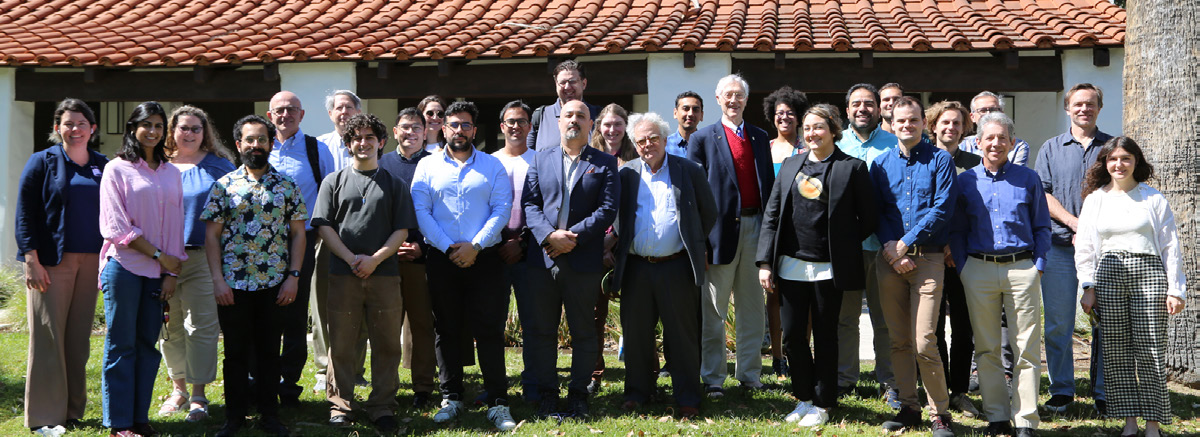
Participants of the Hybrid Space-Ground Observatories Workshop at the Caltech Keck Institute for Space Studies (KISS). (Photo: KISS)
Our Nature Astronomy paper establishes the foundational analysis of key challenges by demonstrating how this idea can be used to observe Earth-like exoplanets from large ground-based telescopes through Earth’s atmosphere, showing the crucial role of Extremely Large Telescope (ELT) adaptive optics in achieving clear observations. We present comprehensive analysis of the expected performance with the three large ground-based telescopes (ELT, Thirty Meter Telescope or TMT, and Giant Magellan Telescope or GMT), showing the full solar system and key biosignatures of life — oxygen and water — in the presence of the actual atmospheric modelling of ELT as a proof of concept. This paper provides a stepping stone toward building, testing, and advancing the concept into a space mission.

Ahmed Soliman with JPL Director Dave Gallagher on the JPL campus. Photo courtesy of the author.
Next Steps Toward the Discovery
How will we build this 99-meter orbiting starshade? That’s nearly the size of the International Space Station! It may sound impossible, but NASA has invested in large-scale wrapped starshade design developed at JPL-ALPS. These efforts have successfully demonstrated shape and deployment accuracy in smaller scalable prototypes. NASA’s NIAC program has also supported studies exploring other implementation methods, including inflatable structures, in-orbit assembly, and the innovative Metashade concept, which uses architected metamaterials and photonic crystals. In addition, a team of 30 experts in engineering and science met at the Caltech Keck Institute for Space Studies (KISS) from March 9–13 to develop a roadmap for turning this concept into a space-ready mission. NASA HQ STMD/NIAC office has also featured our Nature paper and KISS study. Our key findings will be included in the final KISS report, expected in the coming months, and will also be presented in our forthcoming SPIE proceedings manuscript — currently readable in SPIE Astronomical Telescopes + Instrumentation. This effort represents a major milestone toward the highest-performance exoplanet observations from ground-based telescopes, enabling the study of hundreds of Earth-like exoplanets for potential signs of life.
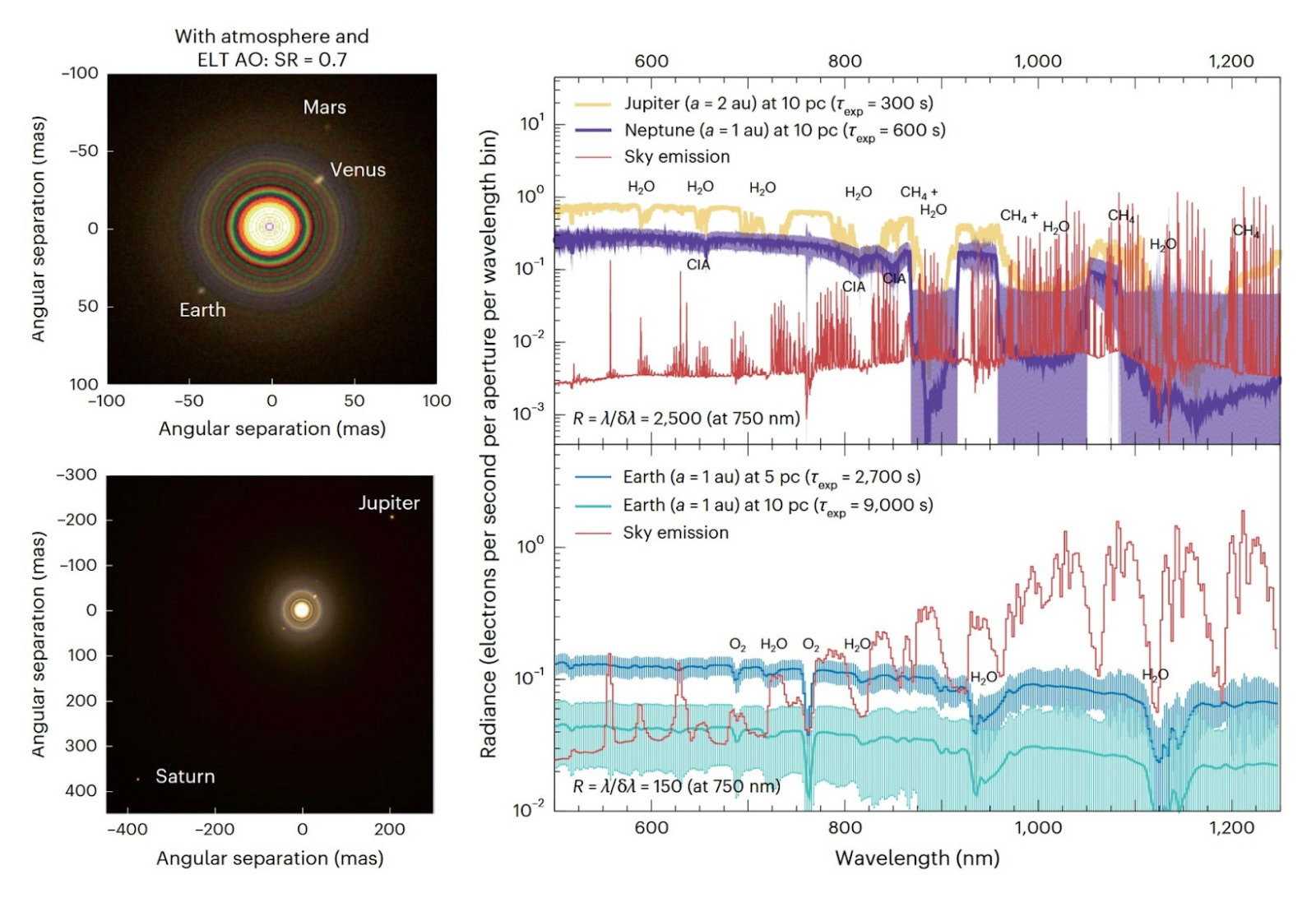
Figure 2 of the paper, which shows we can detect the full solar system through the Earth Atmosphere and ELT AO, including Earth-like Exoplanets in a few minutes and bio-signatures of life (oxygen and water) in a couple hours. (Image: Nature Astronomy)