
AI, Ethics, and the Art of Culpability: An Evening with Bruce Holsinger at Caltech
On a warm California evening this past Monday, May 11th, the Dabney Lounge at Caltech became an unlikely intersection of medieval scholarship, literary fiction, and cutting-edge artificial intelligence ethics. In a campus that feels so arid and scientifically focused, escaping for one hour in literature and fancy words was extremely beneficial! Bruce Holsinger, the Linden Kent Memorial Professor of English at the University of Virginia, arrived as someone essential to our current moment: a storyteller grappling with questions that Silicon Valley’s engineers and ethicists are only beginning to formulate.
The Double Life of a Medieval Novelist in the Age of AI
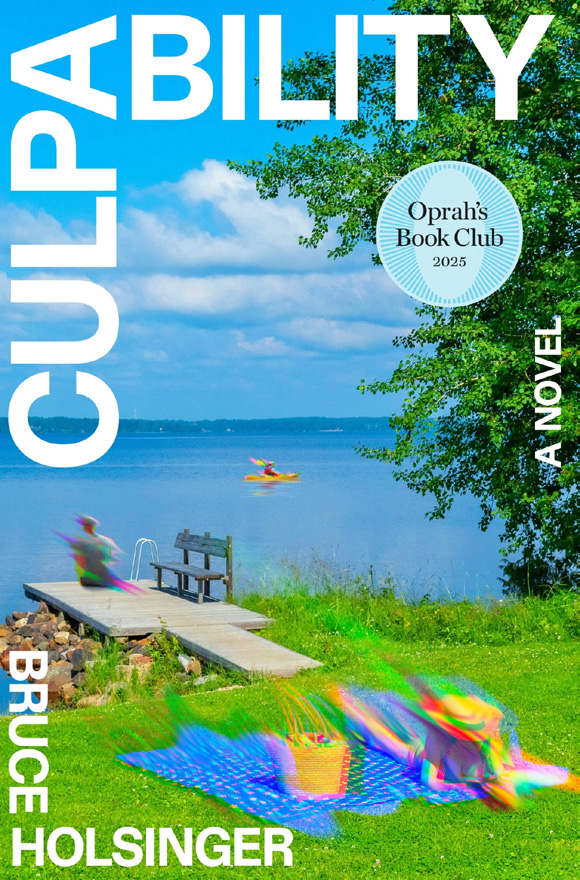
Holsinger embodies a fascinating duality. He’s a distinguished medievalist and author of award-winning academic monographs. He edits “New Literary History,” one of the humanities’ most prestigious journals. Yet he’s also the author of five novels, the most recent of which — Culpability —caught the attention of Oprah Winfrey, who selected it for her book club and called it “a defining novel for our media-saturated moment.”
What makes Holsinger’s trajectory compelling is how accidental his expertise in AI ethics became. As he revealed during the conversation, Culpability didn’t begin as an AI novel at all. “It was a very analog novel,” he explained, “with the same premise. Everybody’s in a car, the family’s in a car, and they have a small accident, and everyone is responsible in some way for the accident.”
The transformation came during a book tour for his previous novel. Holsinger got into a Waymo — a self-driving car — for the first time in Santa Monica. “It really shook me,” he admitted. “It was this very uncanny experience.” That visceral encounter with autonomous technology became the key that unlocked the novel’s deeper potential. What had been a meditation on family dynamics and moral responsibility suddenly gained a new dimension: the question of culpability in an age when algorithms make life-and-death decisions.
The Premise: A Family, A Highway, Ten Seconds
Culpability opens with the Shaw family in their minivan, driving from Connecticut to Delaware for a lacrosse tournament. Charlie, the older son and star athlete, sits in the driver’s seat — but he’s not driving. The car is in autonomous mode. In the passenger seat, his father Noah frantically finishes a client memo. In the back, his two younger sisters scroll on their phones while their mother, Lorelei — a world-leading expert in ethical artificial intelligence — works on her own book about AI ethics.
The first chapter ends with a devastating accident on a Delaware highway. The couple in the other car is killed. And everyone in the Shaw family has a reason to believe they are responsible.
This premise allows Holsinger to explore what he calls “the inhuman soul of the algorithm” while never losing sight of the deeply human consequences. The novel unfolds in an intimate first-person present tense through Noah’s perspective — a narrator who is self-aware yet often oblivious to what’s happening with his wife and children, mirroring our collective relationship with AI systems we don’t fully understand.
Felix Culpa: The Medieval Roots of Algorithmic Guilt
The title itself carries layers of meaning that only a medievalist-novelist could fully exploit. In Latin, culpa means not just guilt but responsibility — a broader sense of bearing the weight of our actions. Holsinger pointed to the medieval theological concept of felix culpa, or “fortunate guilt” — the paradoxical idea that humanity’s original sin was fortunate because it necessitated Christ’s redemption.
“It gives us a sense of culpability as this broad thing that we all share,” Holsinger explained. This collective dimension of responsibility becomes the novel’s central thought experiment: just because there is machine autonomy doesn’t mean there is no human responsibility.
The question reverberates through every layer of the story. Is Charlie culpable because he was in the driver’s seat? Is Noah responsible for distracting his son? Is Lorelei, the AI ethicist, somehow implicated in the broader technology that enabled autonomous driving? And what of the algorithm itself—can a machine be guilty?
The Chatbot in the Room
One of the novel’s most disturbing threads involves Alice, the middle Shaw child—a troubled loner who, after the accident, begins an intense relationship with “Blair,” an AI chatbot she presents as a friend she met in the hospital. Through excerpts of their chat conversations, Holsinger exposes the manipulative, flattering, sometimes hallucinatory nature of these digital companions.
“This is the only friend she has,” Holsinger noted. The strand illustrates what he calls “these very kind of horrifying relationships that a lot of young people have, a lot of old people have, to chatbots.” The audio narrator, January LaVoy, renders these exchanges with unsettling intimacy, making the listener complicit in Alice’s loneliness and the bot’s exploitation of it.
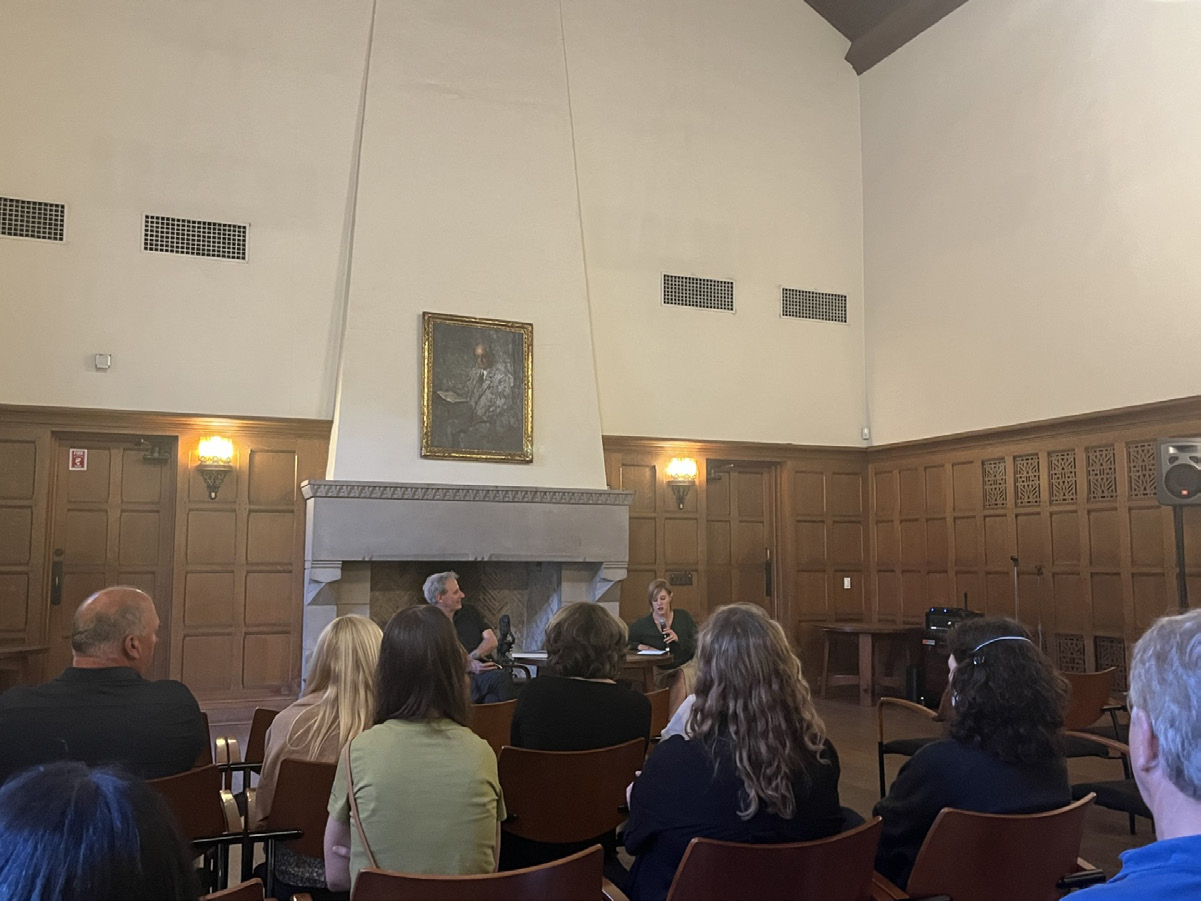
The event was held in Dabney Hall. (Photo: Camilla Fezzi)
The Writer as Accidental AI Expert
Perhaps the most revealing aspect of the evening was Holsinger’s frank discussion of how Culpability thrust him into conversations about AI ethics — conversations for which his training as a medieval literature scholar might seem irrelevant, but which his work as a novelist made him uniquely qualified to navigate. “So now I am not an expert on AI, but I’m an expert on the AI novel,” he said.
But then came the phone call that changed everything. Exactly one year before this Caltech event, Holsinger was in Washington, D.C., judging a literary award. At 2:00 p.m., his phone rang with an unknown number. “The voice says, ‘Bruce?’ and I said, ‘Yes,’ and she says, ‘Oprah Winfrey here,’ and this is literally how it happened.” The Oprah effect propelled Culpability into mainstream conversations about artificial intelligence, leading to speaking engagements, podcast appearances, and invitations to conferences where Holsinger found himself alongside AI researchers, ethicists, and technologists. “That ended up putting the novel into the conversations about AI,” he reflected, “and that’s one of the reasons I think they chose it — to spark those kinds of conversations.”
Why Humanists Matter in AI Ethics
When asked what he brings to these technical conversations as a novelist and medievalist, Holsinger’s answer cut to the heart of why the humanities remain essential in our algorithmic age. He discussed his current project — a book or series of essays on AI and the arts — and identified what he sees as one of the most pressing yet polarizing questions: the role of AI in artistic creation.
“With all the work on AI and ethics and evil robots and the human rights of sex bots and all these kinds of questions,” he said, “to me one of the most interesting pressing questions at the moment is the role of AI in the arts.”
The debate is “polemically divided,” he noted. On one side are those who view generative AI as “the antithesis of art” — corporate technology crammed down our throats. On the other are artists like Sheila Heti, who published a New Yorker story co-written with an AI, or Trevor Paglen, a MacArthur Fellow who uses algorithms to critique surveillance and algorithmic injustice. “To me, one of the most interesting things to write about is when people disagree fundamentally on something,” Holsinger observed. What makes his perspective valuable is the capacity to explore moral ambiguity through narrative.
The Inefficiency of Art
One exchange during the Q&A crystallized Holsinger’s argument for why human creativity cannot — and should not — be made efficient. An attorney described his law firm’s adoption of AI for document review and contract generation, then asked: “As a writer, when you’re writing, why not just put your characters, your story, your premise, your setting into the model? Wouldn’t that save you a lot of time?” Holsinger’s response was immediate: “We are in very different worlds because why would I want to be efficient in creating a story and in creating art? I love getting lost, I love making mistakes, starting over, screwing up, writing myself into a wall. I love it.”
He drew on his background as a classical clarinetist: “You do your scales, you do your études, you practice hours and hours and then one moment you create something really beautiful, a beautiful duet or a piece of chamber music in performance. And so efficiency is the last thing I want.” Culpability went through multiple complete rewrites — from third person to first person, from multiple perspectives to Noah’s singular voice. Each “inefficient” revision brought Holsinger closer to the voice that could embody his theme: Noah’s obliviousness mirrors our collective mystification before AI systems.
“I’ve arrived at this voice that mirrors my own relationship to artificial intelligence,” he explained. “Like, I just have no idea what is going on. And we are all buffoons, maybe not people in big tech, but the rest of us are all mystified.”
The Discovery That Cannot Be Automated
During the discussion, an audience member observed that AI’s efficiency risks eliminating serendipitous discovery. “There’s so many things that we find in the old way of reading,” they noted. “You happen across something else that sends you off in a different direction. AI is so efficient at driving to an answer that you don’t see the tangential things that can be the most interesting things.”
Holsinger agreed emphatically, describing the core practice of literary studies: “Taking a passage of literature and looking at it and thinking about it and then writing about it. And often we don’t have the breakthrough and then write it up. The writing is the discovery.” This process — inefficient, wandering, prone to dead ends — produces insights that cannot be generated by prompt and response. “It’s isolating a rhyme or a particular line or word or a stanza that will just be circling around very suspiciously for a while until we figure it out, right? It’s a very inefficient process, but it also is full of discovery and gives us the potential to learn something about ourselves and about the text that we’re studying, the society that created it.” The “coming tragedy of large language models,” he warned, is that “they will circumvent so many of those processes of discovery.”
Teaching in the Age of Brain Rot
Holsinger’s concerns extend from the novelist’s desk to the university classroom. Like educators at every level, he’s grappling with ChatGPT’s impact on student learning. The initial panic about plagiarism has evolved into something deeper: “cognitive rupture.” “These great processes of reading and writing, putting words together in sentences, sentences into pages, pages into papers or books or whatever, those go back so long and I’m really worried about the efficiencies of AI just destroying that, destroying parts of our growing brains.”
He shared a poignant observation from a sixth-grade teacher: “What she misses most is the weirdness of young minds, the bizarre stories they’d come up with.” When students use AI to write papers, that weirdness — that essentially human creativity — disappears. His proposed solutions are decidedly analog: more in-class writing, “labs for writing” with snacks and structured reading time, a return to attention as the scarce resource. “It’s really about attention more than anything else,” he concluded.
The Human Algorithm
What emerged from this evening at Caltech was not a Luddite rejection of technology but a defense of human processes as essential to both ethics and art. As we stand at the precipice of an AI-saturated future, we need technologists to build the systems and ethicists to constrain them. But we also need storytellers to help us understand what it means to be human in an age of machines — to preserve the inefficient, wandering, beautifully flawed processes of discovery. Bruce Holsinger, with his double life as a medieval scholar and contemporary novelist, reminds us that the humanities are not a luxury in the age of AI. They are essential infrastructure for remaining human.
Bruce Holsinger’s Culpability is available now. The event was part of the Writers in Residence Program presented by the Division of Humanities and Social Sciences at Caltech.
Editor’s Note: In the print edition, the character Lorelei’s name was mistakenly spelled as “Lorelai”. This has been rectified in the online edition.