
Opera’s Rising Stars: The Pasadena Vocal Competition
All photos taken by Edie Tyebkhan Photography.
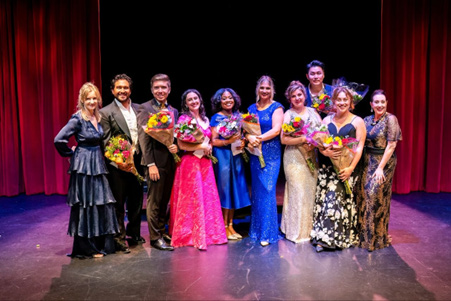
All singers, the pianist (left), and the mistress of ceremonies (right).
In the bubble of STEM academia, the ages 22-33 are reminiscent of college graduations, graduate studies, and perhaps a postdoc or two while navigating the faculty search process. Along the way, scholars may assemble portfolios and grants alike to request funding for their studies.
The musical world is not too different from ours.
On April 11, 2026, eight young classical singers showcased their portfolios and competed for grants in the final round of the Pasadena Vocal Competition (PVC) to further their own studies in classical voice. Each singer performed three vocal selections - two from opera (one in English) and one from musical theater.
The Mistress of Ceremonies was Soprano Jamie Chamberlain, a seasoned performer and master voice teacher with a flair for the dramatic at levels which I aspire to have in my own lectures.
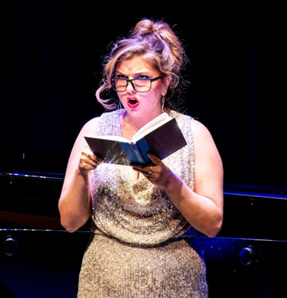
Soprano Emily Damasco singing “Adelaide’s Lament.”
Though the judges did not publicly divulge their criteria for ranking the contestants, the high overlap between their evaluations and mine suggests that I may have a promising side-career as an opera critic. So what was I looking for? Three things - (1) Diction - the listener should be able to understand the words, or at least discern them. (2) Acting - for opera is a performing art, after all, and even though they stand isolated on stage, all of the selected pieces belong to stories with the narrative conveyed through music. Finally, (3) Technique and musicality - the ideal singer demonstrates strong vocal technique without sacrificing the melody and musicality of the piece.
Soprano Emily Damasco (Age 25, Curtis School of Music) opened the program with an awe-inspiring display of vocal finesse and power. I especially enjoyed her acting in “Je suis encore tout étourdie” from Manon by Jules Massenet, in which a young French woman delights in the new sights about her.
You can watch one of Damasco’s performances of this aria here.
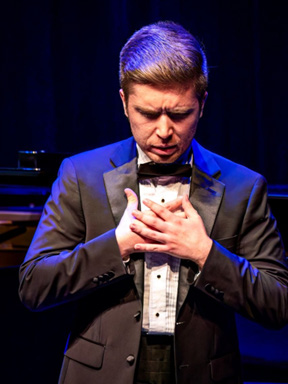
Bass-baritone Evan Lazdowski.
Her performance of “Adelaide’s Lament” from the musical Guys and Dolls (Frank Loesser), full of accelerated rhythm and challenging enunciation, was a great closing piece to her set.
Damasco placed third in the competition. She is currently the Domingo Colburn-Stein Young Artist with the Los Angeles Opera. You can find her on Instagram at @emilyydamasco.
Those familiar with Shakespeare’s works will recognize the play “A Midsummer Night’s Dream”, which has been adapted countless times for the stage and screen - including, for example, by EXPLICiT early in May - but did you know it was also adapted into an opera?
Bass-baritone Evan Lazdowski (Age 27, Manhattan School of Music, The Juilliard School) performed “When my cue comes, call me” from Benjamin Britten’s adaptation. In this piece, the protagonist Nick Bottom wakes up from his misadventures in the fairy world and searches frantically for his fellow actors. Though Lazdowski did not place in the competition, I especially enjoyed his creative use of the environment - stage, doors, and even the piano - in setting the scene.
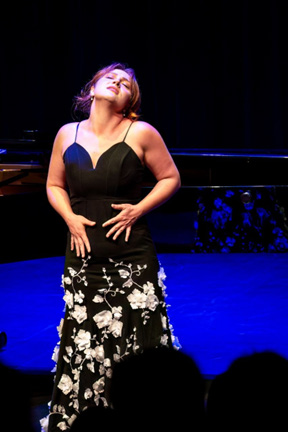
Mezzo-soprano Ashlyn Brown.
Mezzo-soprano Ashlyn Brown (Age 28, Indiana University) won second place and the Audience Favorite award, undoubtedly for her second piece, “I don’t have to do a thing” (also known as the Ice Cube Aria) from If I Were You by Jake Heggie. Her exceptional vocal performance was enhanced by her sly and smug facial expressions as she sang the part of the Devil, disguised as a bartender who compares the predictable descent of humanity to an ice cube that slowly melts in a beverage.
You can watch Brown’s haunting performance of this aria here.
Ashlyn Brown has most recently performed with the Opera Theatre of Saint Louis and the Music Academy of the West. You can check out her full bio and sample performances at ashlynbrown.com.
The star of the show, the first place winner, and my personal favorite was Son Jin Kim (Age 30, Seoul National University, The Juilliard School), whose certain victory was heralded by the deafening applause at the conclusion of his performance.
Kim’s first selection, “La calunnia” from Rossini’s The Barber of Seville, was sung with such technique and fortitude that when I closed my eyes, I believed myself in a grand theater with an experienced veteran. It was Kim’s second piece, “I’m a lonely man, Susannah” from Susannah by Carlisle Floyd, that - in my opinion - secured him the first place position that night. His piercing stare and deep, dark tones captured the character’s twisted loneliness as he becomes infatuated with the titular Susannah.
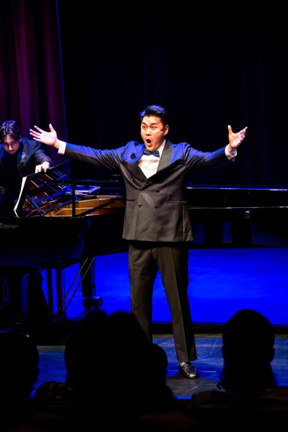
Bass Son Jin Kim.
I’m no expert in Italian, but for his English pieces, including his third selection, The Impossible Dream from The Man of La Mancha, Kim’s enunciation was impeccable.
You can watch some (or all) of a special recital by Kim at this link.
Son Jin Kim also has an Instagram account at @bass_sonjin_kim.
I’m eager and excited to follow Kim’s professional career. I am confident he will captivate and mesmerize audiences as he did myself and the judges that night. Rest assured that if he returns to perform in the LA area, I will purchase whatever tickets necessary to watch him again.
The last finalist I want to mention is soprano Sunwoo Park (Age 32, Seoul National University, University of Southern California), who was the final performer in the competition. It was a special delight to watch Park, who is a coloratura - a technique characteristic of complex embellishments in the melody. Sopranos (or any voice part, for that matter) who sing in this style are expected to deliver pitch precisely while performing demanding vocal acrobatics.
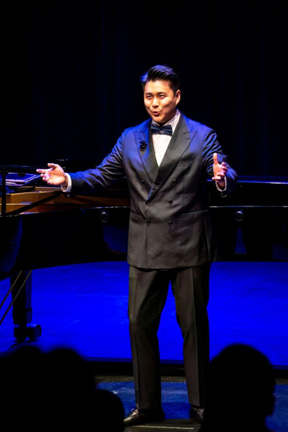
Son Jin Kim, again (I couldn’t pick just one photo!).
You can learn more about Sunwoo Park at her website sunwooparksoprano.com.
The final act of the night – while the judges were deliberating – was the winner of the Chevalier award for the best performance of an aria by a composer from the African diaspora. Soprano Candace Williams (Age 29) performed “Whisper Walk” from The Snowy Day by Joel Thompson. Her melodic voice floated like soft snowflakes in this musical depiction of winter.
The Chevalier award, sponsored by actor Courtney B. Vance, is named after violin prodigy and composer Joseph Bologne, Chevalier de Saint-Georges (1745-1799), who was of French and African descent. I personally discovered this composer on one of my eighteenth century rabbit holes several years earlier. He has often been compared to Mozart for his vibrant orchestration but slightly predates the famous Austrian. He is a very fascinating figure, both historically and culturally, and I highly recommend any of the wonderful sources on his life and music.
Following the awards announcements, audience members (including myself) went to the stage to congratulate our favorite participants. I appreciate that everyone at the competition was a winner – those who did not place received smaller sums of grants – and that the atmosphere was one of celebration and community.
Once again, I applaud all the singers at the Pasadena Vocal Competition for their brilliant performances and all the years of training that led up to those special moments I cannot wait to watch next year’s program and meet the next ensemble of the young stars of opera.
Catch all the latest updates at pasadenavocalcompetition.org.
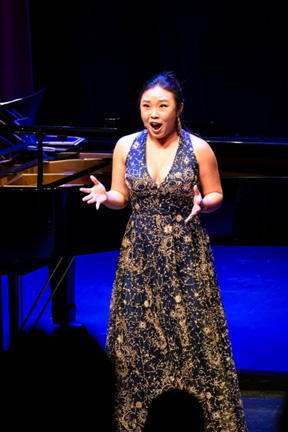
Coloratura soprano Sunwoo Park.