
Integrated Core, One Year Later

Excited Integrated Core students on the first day of fall classes. (Photo: Caltech Core Curriculum)
On a Saturday afternoon this spring, part of Caltech’s inaugural Integrated Core cohort found itself somewhere few first-year lab sections go: wandering the aisles of Home Depot.
They were looking for tubing, buckets, connectors, and whatever else might help them build small-scale carbon capture systems from scratch. One group was growing algae. Another was working with limestone. A third was thinking through carbonate chemistry and industrial slag. The problem was not to follow a protocol, but to design one: take carbon from the atmosphere, or find a way to store it, and prove that something had happened.
The sensors, it turned out, were not especially helpful. Graduate TA Yuri Tamama (GPS), who helped run the geology labs, recalled testing inexpensive CO2 sensors that had arrived from Amazon. In a nitrogen chamber, some still read ordinary atmospheric CO2. When exposed to methane, they interpreted it as carbon dioxide. In a vacuum chamber, they crashed entirely.
“They were total bums,” Tamama said.
It was, in other words, a lab failure. It was also exactly the point.
“I think it really gave students valuable insight into what science and research is actually like,” Tamama said. “There’s a distinct difference between what you do in standard classes and in science. Because in science, you design experiments and figure out what materials you need, and you’re basically doing something where you don’t know whether it works.”
Last fall, the Tech reported on the launch of Integrated Core, Caltech’s pilot first-year alternative to the standard Core curriculum. Organized around the theme of energy, the program brings a small cohort of first-year students through a 27-unit, three-term block spanning physics, chemistry, biology, mathematics, earth science, and humanities. The premise was ambitious: rather than asking students to discover connections between disciplines after the fact, Integrated Core would make those connections the curriculum itself.
At the time, much of the program still existed in future tense. Fall would use space travel to connect mechanics, fuel chemistry, planetary science, and ethics. Winter would turn to bioenergetics. Spring would take up carbon capture and climate. The humanities sequence, taught by Dean Jennifer Jahner, would move from space law and ethics to Caltech archives and hydropower, then to Octavia Butler’s Parable of the Sower.
Now, after two more terms, the pilot has become less a proposal than a lived experiment: sometimes polished, sometimes improvised, sometimes overfull, and, by many accounts, unusually beloved.
“I’m honestly really impressed with the degree of coherence between subjects,” said Vedant Ganesh, a member of the inaugural cohort. “I wasn’t 100% sold when I signed up. There was this degree of uncertainty, as there is with every experiment. It really has gone well.”
From Owens Valley to Big Creek
If fall began on the road to Coso, Mono Lake, and Manzanar, winter brought the road back to Pasadena.
Dean Jahner had known from the beginning that she wanted Integrated Core students to spend time with the Caltech Archives. As she saw it, the archives offered more than institutional memory. They offered a humanities laboratory: a place where students could confront objects whose meanings were not already settled.
“We have an incredibly rich institutional history that’s right down in the Beckman sub-basement,” Jahner said.
Peter Sachs Collopy, Caltech’s University Archivist and Head of Archives and Special Collections, joined Jahner in co-teaching the winter humanities term. Together, they designed the course around the history of water, power, and Los Angeles: especially the ways Caltech’s early development overlapped with the rise of hydroelectric infrastructure in Southern California.
The first-year field trip had already introduced students to the hydropolitics of the region, including Owens Valley and the Los Angeles Aqueduct. Winter asked them to trace a related history: how electric power, money, engineering, and institutional ambition flowed through Pasadena and Los Angeles in the early 20th century.
“What we found as we looked at the relationship between the history of hydroelectricity in Southern California and the history of Caltech,” Collopy said, “was more and more points of contact between them. More than we expected!”
One starting point was the building now known as Linde Hall, originally constructed in 1923 as the High Voltage Research Laboratory. As Collopy described to the Tech, the lab was funded by Southern California Edison as a place to test transmission equipment at very high voltage. It also housed a million-volt transformer designed by Royal W. Sorensen, the founder of electrical engineering at Caltech.
The building’s history unfolded like that of twentieth-century science in miniature: from high-voltage electricity to X-ray research to medical physics to early particle acceleration.
For Collopy, that story opened onto a broader regional history. California’s electrical system developed differently from much of the United States, relying heavily on hydroelectricity rather than coal. Investors, engineers, architects, and institutions moved between Caltech and the electric industry. Henry Huntington invested in the Big Creek hydroelectric project. The architect Gordon Kaufmann designed both Caltech buildings and Hoover Dam. John B. Bock, whose donation helped build the Athenaeum, worked in engineering assessments of hydroelectric projects.
“There are these people who are moving, whether they’re engineers or bankers or architects, between Caltech and the hydroelectric industry and creating these persistent connections,” Collopy said.
Students were asked to build digital exhibitions around these connections. Each exhibit had to weave together three objects: one from the Huntington Library’s Southern California Edison collection, one from Caltech’s physical archives, and one from another source. The resulting projects covered topics from electrical substations and corporate partnerships to Theodore von Kármán’s interest in hydraulic infrastructure.
The result, Collopy said, became something like a collective scholarly project on a subject that doesn’t yet have a book.
“There is no scholarship on the relationship between Caltech and hydroelectricity,” he recalled telling students at the start of the quarter. “This isn’t an established subject. We’re figuring it out in this course.”
That uncertainty was part of what made the class unusual. In many courses, Jahner noted, instructors teach toward a known outcome. Here, she and Collopy were discovering the material alongside the students.
“A lot of this was just so much fun,” Jahner said, “to be on the ground floor of something where you genuinely didn’t know what you were going to find.”
As students reported, the archival work was integral to the later fabric of the course. First-year Selene Wang described winter humanities as a shift into “Caltech history specifically,” with students studying how energy and power were delivered to Los Angeles, how that infrastructure was built, and how Caltech was linked to it.
Gene Huntley, another student in the cohort, called the archival project one of his favorite parts of the year.
“We went to different archives and literally — half of our assignments, I’d say — were going to the archives and requesting some kind of document we had to interpret,” he said. “Primary, secondary documents we could hold. Like the original copy that was literally falling apart.”
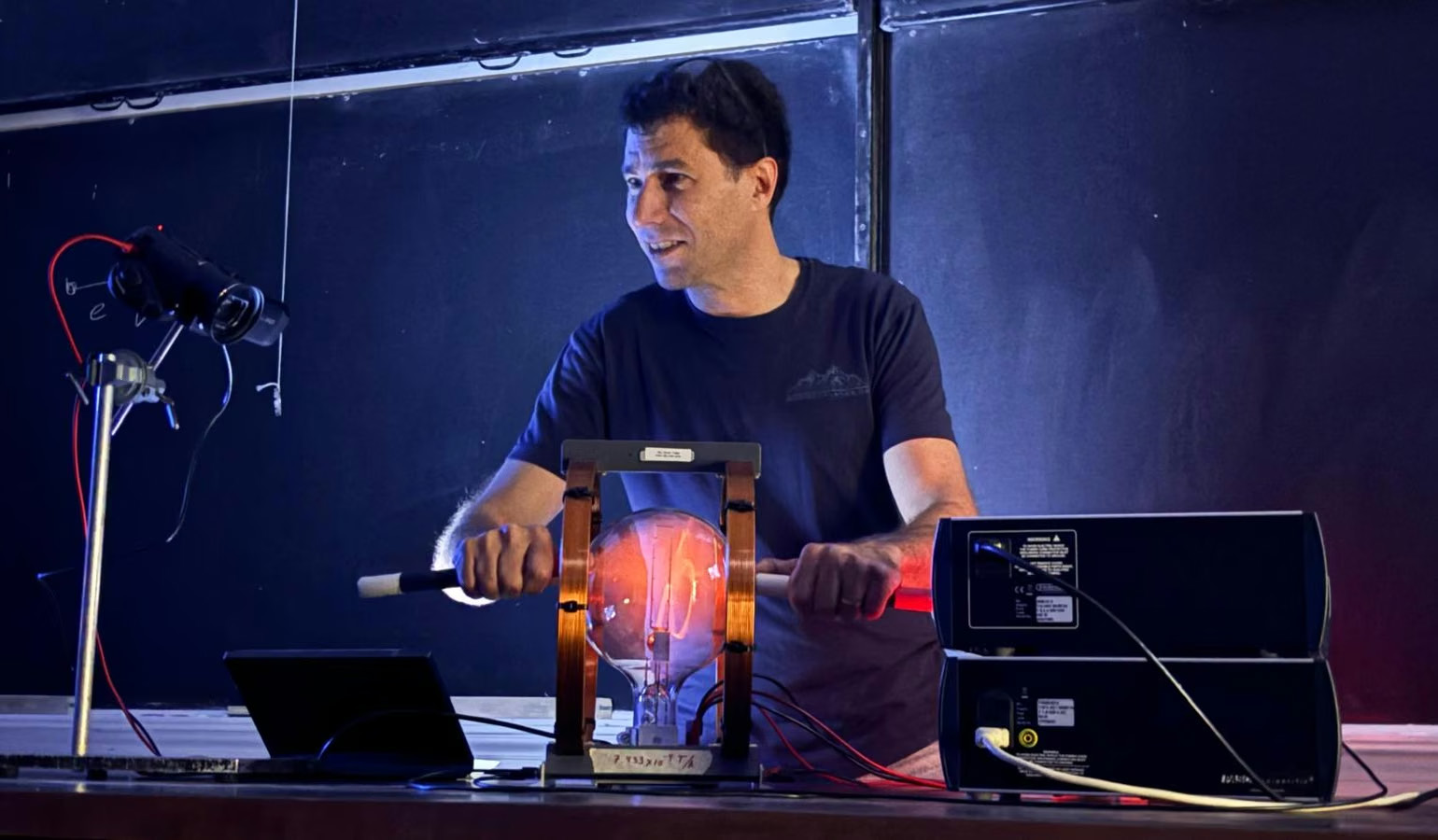
Professor Gil Refael demonstrates a physics concept for Integrated Core students. (Photo: Selene Wang)
The same equations, everywhere
While humanities explored the region’s infrastructural past, the scientific side of winter focused on cellular bioenergetics: how organisms obtain, convert, and store energy. For Wang, the term stayed close to its theme. Biology leaned into metabolism and phosphorylation; chemistry covered thermodynamics and kinetics in biological contexts.
Still, Integrated Core’s most revealing moments often came when the official theme receded and the same mathematical structure appeared in multiple scientific settings.
Professor of Geology and Geochemistry Paul Asimow, one of the program’s central organizers, gave one example from winter. Teaching Professor of Biology and Geobiology Justin Bois had developed a problem involving first-order kinetic rate equations for how the body metabolizes alcohol and acids. Asimow recognized the same equations from geochemistry, where they describe radioactive decay chains.
“I looked at the solution and said, that is exactly the same solution to exactly the same equations in geochemistry,” Asimow said. “So let’s just ask it as the geochemistry question instead of the biochemistry question.”
For Asimow, these were the moments that made the Integrated Core concept feel real. When students learned diagonalization in linear algebra, faculty from across the sciences began finding places to apply eigenvalues and eigenvectors: seismology, climate data, chemical systems, biological systems, physical systems.
“As soon as they learn a new method in linear algebra, we’re all jumping in and figuring out what we can do with it,” Asimow said. “That’s the concept, but it’s been amazing to see it happen.”
Students noticed. Huntley said many of the strongest “integrated moments” appeared not in lectures, but in problem sets, when a technique that had seemed abstract suddenly became useful.
“You get to work it out and go, oh shoot, so that’s where it came from,” he said.
Winter also brought new forms of assessment. Professor of Electrical Engineering Glen George, teaching physics from the standpoint of practical energy technology, asked students to write a textbook to complement the winter physics material rather than take a conventional exam. Professor of Biology and Geobiology Dianne Newman’s hypothesis-oriented research proposal assignment matured into a format modeled on the NSF Graduate Research Fellowship proposal.
For Asimow, that was a “nice twist”: an assignment that could have been a SURF-style proposal become practice in a format many students may encounter again if they apply to graduate school.
First-year Michelle Lu also pointed to the proposal project as one of the year’s most meaningful experiences. Students chose a complex scientific problem, identified a knowledge gap through literature review, consulted Caltech faculty, and developed a specific, falsifiable hypothesis with a proposed way to test it. In winter, that work culminated in a five-minute chalk talk or elevator pitch; in spring, it expanded into the NSF-style written proposal.
“This project was especially valuable,” Lu wrote over email, “as it provided us early training into becoming thoughtful and professional scientists in the future.”
For Lu, the unusual assignments were part of what made the pilot valuable. Integrated oral exams, chalk talks, the space-travel ethics project, and the NSF-style proposal all asked students to do more than absorb content. They had to adapt, collaborate, and keep working inside a course whose own shape was still being refined.
“I truly believe that IC taught me not only the foundational knowledge,” Lu wrote, “but trained me with the necessary skills like intellectual adaptability and collaborative perseverance.”
That same adaptability shaped the curriculum itself. The program was still changing as it ran: faculty meetings generated new connections, assignments shifted, and the rhythm of lectures, problem sets, labs, and integration had to be discovered in real time. That, too, was part of the pilot. Integrated Core was not only asking students to work across disciplines; it was testing, week by week, what interdisciplinary teaching could look like.
For first-year Maxwell Yu, that improvisation did not mean the larger structure disappeared. If anything, he said, the second and third terms asked students to take more responsibility for seeing the connections themselves. Fall’s space-travel theme had been more explicit, while winter became, in his phrasing, “energy on our world”: biological ecosystems, ecosystems, atmospheres, power distribution, and the history of electricity in Los Angeles. Spring then turned toward “the future of energy on planetary timescales,” through carbon capture and climate.
“It’s more on a day-to-day level that things became less like planned from the start,” Yu said, “which is not necessarily a bad thing.”
Professor of Physics Gil Refael described the same structure from the faculty side. Winter, he said, used electricity as a mechanism for teaching electromagnetism, electrochemistry, and bioenergetics, while spring paired geophysics and geochemistry on carbon capture with physics units returning to space travel, special relativity, and optics. Refael said he was less attached to a single overarching theme than to a set of themes (carbon capture, energy, space exploration) that faculty could engage at roughly the same time.
“I was timing the discussion of flagellum motors with the chemistry discussion of ATP,” Refael said. “I think chemistry was aligning the discussion of electrochemistry with the discussion of batteries and static electricity.”
Carbon, climate, Butler
In spring, the scientific theme shifted to carbon capture and climate. The geology component became especially project-based. Students heard from guest speakers working on carbon capture technologies, then split into groups to design laboratory-scale demonstrations.
Wang’s group worked with microbes. Others explored industrial slag or carbonate chemistry. Ganesh worked on accelerated weathering of limestone: dissolving CO2 in water at elevated pressure, then pumping it through limestone so an acid-base reaction would remove carbon from the gas stream.
His role was to verify that carbon had actually been removed from the inlet gas. To do so, he emailed researchers outside the Integrated Core faculty for advice on measuring CO2 concentration, borrowed a trace-gas analyzer, and made his own gas samples.
“Everything is very do-it-yourself,” Ganesh said. “I really enjoyed the option to design my own labs.”
This was the spring lab’s guiding philosophy. Students were not simply performing known demonstrations. They were deciding what counted as evidence, what equipment they needed, and what to do when the apparatus failed.
For Tamama, who will TA Integrated Core again next year, this made the course unlike any previous TAship she had done.
“When I taught classes with labs previously, it was pre-established,” she said. “We had everything on a Google Drive and the equipment there. Now we’re figuring out: We have this, not this, but does this equipment work?”
Asimow described the same experience as “running back and forth between Crellin and the IC building and various GPS buildings” to scrounge up lab equipment.
In another course, such improvisation might have been a sign of disorder. In Integrated Core, it became part of the pedagogy. The students were learning not only carbon chemistry, but the structure of experimental uncertainty.
“You don’t know what’s going to work,” Tamama said. “It might fail. But hey, that’s science.”
Spring also brought the humanities sequence to Octavia Butler’s Parable of the Sower. For Jahner, Butler provided the year’s most resonant convergence. Butler was a native Pasadenan whose papers are held at the Huntington Library. Her novel, set in the 2020s, imagines a climate-ravaged, violently unequal Los Angeles and follows a young protagonist traveling north in search of water and survival.
“Butler sort of brings together the local Pasadena history that we were looking at in the winter quarter with Throop and Caltech,” Jahner said, “but then adds a very distinctive lens that she would bring as a young woman growing up in Pasadena.”
The move from Caltech’s early elite circles to Butler’s Pasadena was, Jahner said, “a big shifting in the ground.” Winter had asked who built Caltech and the infrastructure around it. Spring asked who was excluded from that world, and what it meant to imagine futures from the perspective of a segregated city.
Students visited the Huntington to view Butler’s papers, including journals, drafts of Parable of the Sower, and the newspaper clippings she collected on the science that informed the novel.
For Jahner, the visit underlined the unity of the year. Butler’s novel looks to the stars, echoing fall’s utopian and ethical questions about space. It is rooted in local history, echoing winter. It draws on climate science from the ‘80s and ‘90s, echoing spring’s earth science and carbon capture work.
“I was surprised, actually, at how much coherency there was over the course of the year,” Jahner said.
She had designed the humanities sequence to be more than a one-quarter requirement. She wanted it to function as a throughline — a reminder that humanities aren’t something to be siloed into a single building or term, but an analytic lens students could carry into technical problems.
“There’s clearly a version of Integrated Core where you just had an IC hum for one quarter and that was that,” Jahner said. “I very much wanted students to come away with a sense that humanities is not something that you portion off for a term.”
Students reflected that assessment. Ganesh said the humanities component gave students freedom and trust to pursue their own questions, whether space law in the fall or archival research in the winter.
“Dean Jahner is amazing,” he said. “There’s a large element of freedom and trust.”
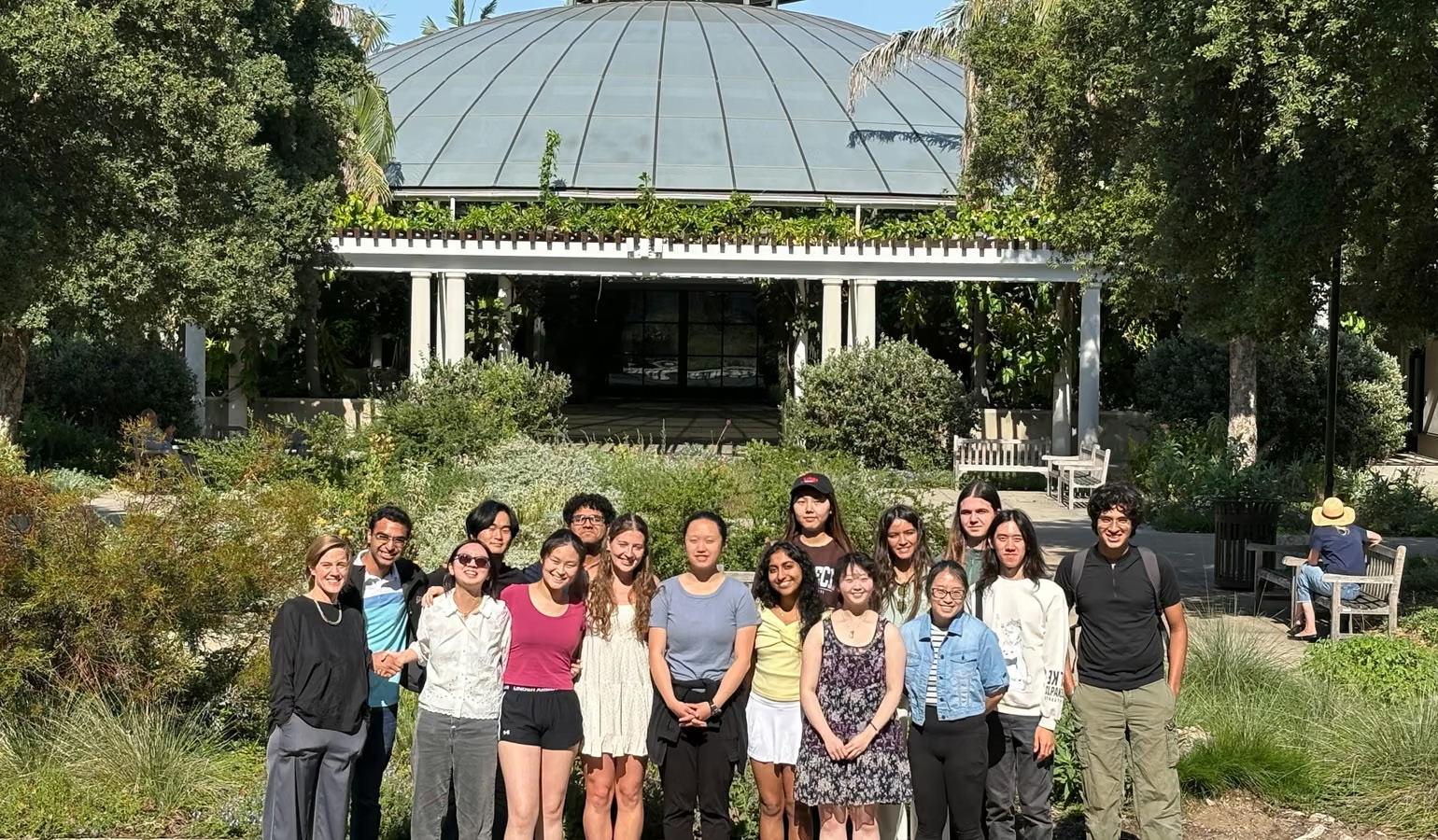
Integrated Core students visit the Huntington Library and Botanical Gardens as part of their spring study of Octavia Butler. (Photo: Caltech Core Curriculum)
A Caltech in miniature
Integrated Core has always been both curricular and social. Its structure creates something like a small school inside Caltech: a cohort of roughly twenty students who share lectures, labs, problem sets, TAs, faculty, and a dedicated basement space.
The closeness has shaped the program as much as the coursework. Wang described the group as “very well-bonded,” with students doing sets together, talking outside class, and spending long hours in their shared space in the BBB basement. TAs bring food. Ramen accumulates. Faculty dogs make appearances. The cohort has a 40-page quotebook, contents classified.
Blood on the Clocktower, introduced during the opening field trip, became a recurring social ritual. What began as a game in the Sierra Nevada turned into weekly sessions involving IC students and others outside the program.
Ganesh called it “basically a 9-unit class for me at this point.”
That community has helped answer one early concern: that joining Integrated Core might isolate students from the rest of the first-year class. Ganesh said his experience has been the opposite.
“Rather than isolating, it’s been enriching,” he said. “Not only do I have the friendships I formed organically in the Houses, but I also have the friendships I formed in IC.”
For first-year Delta Blendea, the program’s small scale also made possible a kind of feedback and attention that would be hard to reproduce in standard Core. She described faculty as unusually responsible: sometimes, in her view, almost too responsive. If a problem set exposed widespread confusion, instructors could adjust quickly; in one case, Bois held an impromptu clarification lecture that same afternoon.
“Pretty much no notes,” Blendea said, offering a glowing review of the year. But the praise came with a revealing caveat. The same attentiveness that made IC feel so unusually responsive could, she suggested, risk becoming too protective.
“This doesn’t happen in regular Core,” Blendea said, “and it’s kind of incredible. One of the best parts of IC is how much attention the faculty can give you.” Still, she added, “Maybe don’t coddle us. We’re Caltech students, like everyone else.”
Lu similarly wrote that Integrated Core shaped her first year not only academically, but socially. Because students spent much of the day together, she formed close friendships through problem sets, shared frustrations, and the ordinary comedy of living through a new program together. At the same time, she said, IC didn’t prevent her from building community outside the cohort.
“Outside of Integrated Core,” Lu wrote, “I still got to socialize with my house and others who were taking normal Core as well.”
Still, the program isn’t frictionless. Students emphasized that Integrated Core can ask for more time than standard Core, especially in heavy weeks. Wang said the program is best suited for students who want to invest heavily in their first-year academic experience and are excited by interdisciplinarity.
“If you want to do one thing really well, then don’t do Integrated Core,” she said. “But if you want to get a lot out of your first-year Core experience… I think this is a great way to do it.”
Huntley offered a similar appraisal. Students who already know they want to focus narrowly on one field may prefer standard Core and advanced coursework. But for students who want to explore the intersections of disciplines, he said, Integrated Core is “100% a must do.”
He also pointed to one area where the program may still need adjustment: physics. Some students, he said, struggled when physics lectures moved too quickly or felt disconnected from the fundamentals. In the third term especially, physics could feel overwhelming.
“Sometimes the physics can jump from 10 to 100,” Huntley said.
Such issues are part of what faculty expect to refine. Asimow said next year will follow broadly the same structure, but with the advantage of having built the course once already.
“Having the base for all the assignments, all the lectures, all the exams done at least once gives us time either just to turn the crank again, which would be boring, or improve it — iterate on it, make it better,” he said.
Tamama expects the same. With one year of data, faculty and TAs have a better sense of how long problem sets take, where students struggle, and which lab equipment actually works.
“We have learned a lot about what works and what doesn’t,” she said.
What survives the pilot?
Integrated Core is approved for two years, with many of the current faculty committed to teaching it again next year. After that, its future will depend on further faculty discussion. Asimow said the faculty board approved the program for two years, and the team will need to report on its progress and seek permission to continue.
In the short term, Collopy said, the winter archives section will return next year, again co-taught with Jahner. Beyond that, he sees the course as evidence of what archival work can offer Caltech students whether in Integrated Core or elsewhere.
Archives, he said, are not simply repositories. They are tools for asking questions when the answers are not already organized.
For Jahner, the first year has validated the idea that humanities can remain present throughout an intensive scientific curriculum: not as ornament, but as method.
“For me, the point has been I’ve learned a tremendous amount in teaching and being involved in this course,” she said. “The fact that humanities could be a part of that all the way through is realizing that kind of dream for me, too.”
For Asimow, Integrated Core has offered a unique opportunity to teach science in the way he thinks science actually works: connected, improvisatory, mathematically recurring, and oriented toward real problems.
“From a faculty perspective, it’s been enormously fulfilling and satisfying to teach this way,” he said. “It’s really the most fun I’ve had teaching.”
Ganesh, looking back on the year, offered his own unifying theme. Officially, Integrated Core is about energy. In practice, he said, it was also about trust and freedom: trust that students were trying hard, and freedom to explore a problem deeply enough for it to become their own.
“I think IC has succeeded with flying colors,” he said, “in its ability to give students the opportunity to come out of Core without becoming jaded by the number of assignments and by the grind that comes with Caltech.”
By spring, the original question — could first-year science be taught as one edifice rather than many silos? — had become less abstract. It looked like students in the archives, piecing together Caltech’s hydroelectric past. It looked like first-years reading Butler’s climate future in the city where she grew up. It looked like a Home Depot run for a lab that did not yet exist, a bad CO2 sensor in a vacuum chamber, and a group of students learning that science begins not when the apparatus works, but when it doesn’t.
“The unifying theme of IC, if I may, is theoretically supposed to be energy,” Ganesh said. “But I’d say the secondary unifying theme, in my experience, has been trust and freedom.”
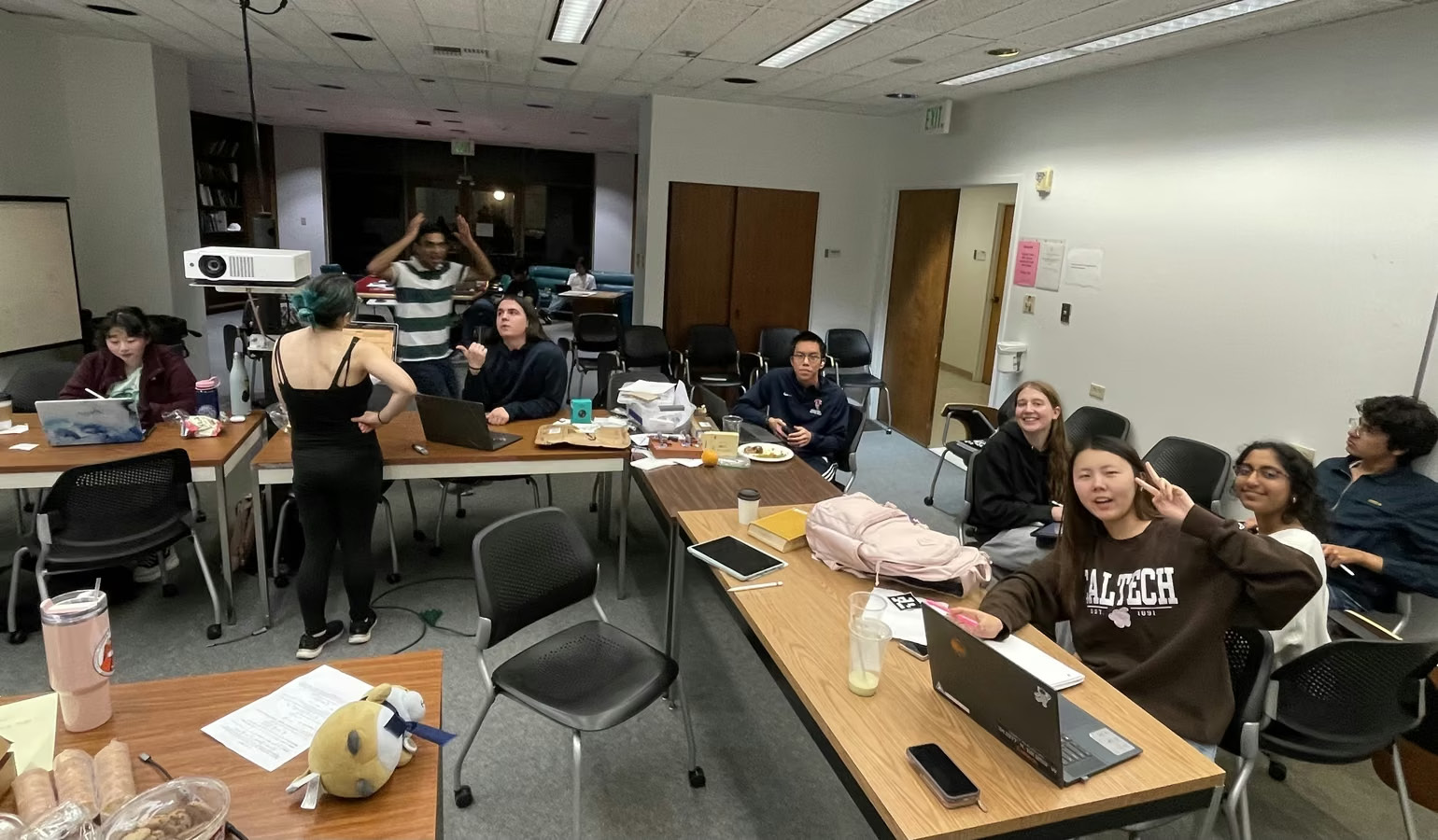
Integrated Core students and Tamama work on a cross-disciplinary “C” problem set in the program’s dedicated BBB B101 classroom and lounge. (Photo: Selene Wang/Caltech Core Curriculum)