From Nightclub Door Lists to Fashion’s Front Row: The Unlikely Journey of Melissa Magsaysay

There’s a particular kind of audacity required to fail spectacularly at being a cocktail waitress and somehow turn that failure into a career-defining opportunity. Melissa Magsaysay has made a career out of this kind of alchemy—transforming what others might see as limitations into launching pads, and using fashion journalism to reshape who gets to be seen and heard in an industry notorious for its gatekeeping.
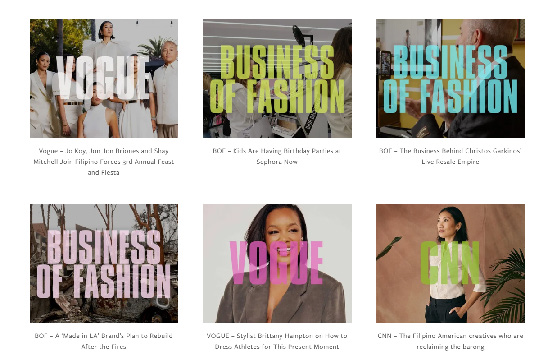
Today, as host of the LA Times Studios podcast “Living Well,” a contributing writer for Business of Fashion and Vogue Philippines, and co-founder of Duster—a fashion brand built around the Filipino house dress—Magsaysay has become something her 11-year-old self, thumbing through fashion magazines in the San Francisco Bay Area, might not have imagined: a voice who uses fashion as a lens to examine larger questions of representation and cultural heritage.
The Education of Curiosity
While most children might casually flip through magazines, young Melissa consumed them with precision. “I would actually just lay on my bed and I’d color in the models’ faces, I knew everybody’s name, I knew what agency they were with, I knew all the editors’ names,” she recalls. “It was just my thing.”
By high school, she had joined the school paper. In college in Boston, she wrote for the Boston Phoenix and interned at the Boston Globe. “I kept just taking the next thing, like whatever opportunity was available to me,” she explains.
But when she arrived in New York after college, armed with published clips and unshakeable determination, she hit the wall that stops most aspiring fashion journalists: “People started telling me like, it’s really about who you know in fashion.” The solution? Get a job where knowing people was the actual job description.
The Door, the List, and the Power of Seeing
Amy Sacco, the nightlife impresaria behind some of early 2000s New York’s most exclusive venues, recognized what Magsaysay herself might not have fully understood yet: her value was in her eye—her ability to curate, to see what fit and what didn’t. “She saw what a terrible cocktail waitress I was,” Magsaysay admits with characteristic candor. “She’s the one who said, ‘Well you dress really cute, I know what you want to do. I’m going to put you at the door, I know you can do that and you put on an outfit and talk to people, but you cannot do anything inside the restaurant.’”
That door became Magsaysay’s real internship. Standing outside in freezing temperatures, she wasn’t just checking names—she was building a network, one conversation at a time. “People wanted to get in and I kind of inadvertently used that opportunity to curry favor and meet people,” she explains. Those conversations led to her first fashion week internship doing “front of house”—checking people into shows.
The lesson wasn’t lost on her. When she finally landed her first real job at Women’s Wear Daily, she sent Sacco an email: “I got this job and it’s not the front row, but I can see it.”
Los Angeles: The Unfashionable Frontier
In 2004, Women’s Wear Daily offered Magsaysay a job that most New York fashion editors would have considered career suicide: covering the West Coast. Los Angeles was dismissed as the land of swimwear, premium denim, and fast fashion—decidedly unglamorous compared to the haute couture houses of Paris or the established New York fashion week circuit.
Magsaysay took it. What the New York establishment failed to see—but what Magsaysay’s training in curiosity helped her recognize—was that LA was on the verge of a fashion explosion. “The West Coast really exploded during that time,” she notes. “Like, really exploded.” As the only major fashion trade reporter on the ground, Magsaysay had access to an entire ecosystem of innovation. She visited factories in Vernon, met with the skate and surf brands in Orange County, covered the premium denim revolution that was redefining American casual wear, and watched as fast fashion pioneers like Forever 21 reshaped retail.
For three years at Women’s Wear Daily, then five more as style editor at the LA Times—where she launched their first standalone style section called Image—Magsaysay helped define how the industry understood this new geography of style, one where celebrity culture, streetwear, and manufacturing expertise were creating something new.
The Pivot to Beauty: The Lipstick Index and Human Stories
The 2008 economic downturn forced another evolution. “It was really hard to talk about fashion to such a mass audience” during a financial crisis, Magsaysay explains. So she pivoted to beauty—a sector that thrives during downturns, thanks to what economists call the “lipstick index,” the phenomenon where consumers continue to purchase small luxuries even when cutting back on bigger expenditures. But Magsaysay’s approach to beauty coverage created stories that served her audience’s actual needs, like her drugstore beauty feature where she and a makeup artist went to CVS, tested products, and rated what actually worked. “What people do on TikTok today, like all the time,” she notes. “This was just a lot more rigorous.”
This instinct—to serve the audience’s reality rather than the industry’s fantasy—would become a hallmark of her work and would later inform her approach to building Duster.
Cultural Identity as Editorial Strategy
As Magsaysay progressed in her career, she began to notice something remarkable: Filipino excellence emerging across the fashion and beauty industries in unprecedented ways. In a six-month period in 2023, she had interviewed more Filipino people for various stories than in her entire previous career.
“I had interviewed more Filipino people just for random other stories that had nothing to do with being Filipino, just fashion, beauty, whatever stories,” she recalls. “And they were in really big positions, they were doing really cool things.”
This observation became a story for Elle magazine, profiling Filipino leaders across fashion and beauty: Raisa Gerona, chief brand officer at Revolve; Rhuigi Villaseñor, creative director at Bally and founder of Rhude; Jian DeLeon, men’s fashion director at Nordstrom; and Frederic Aspiras, Lady Gaga’s hairstylist who won an Oscar for his work on “House of Gucci.”
The piece resonated deeply. “Filipinos I think are just by and large not used to seeing themselves front and center in Western media,” Magsaysay observes. “I got a lot of feedback from the community that it was good and it resonated.”
The Barong Story: Personal History Meets Cultural Journalism
Perhaps no story better illustrates Magsaysay’s unique position than her CNN piece on the barong tagalog, the traditional Filipino formal garment for men. The barong is made from piña (pineapple fiber) or abaca (jute rope), features intricate embroidery, and is designed to be airy and sheer for the Philippine climate. Magsaysay noticed young Filipinos wearing barongs in increasingly creative ways—with tattoo art incorporated into the design, styled in contemporary contexts, reclaimed from its purely ceremonial role.
But she also had a personal connection to the story: her great uncle was Ramon Magsaysay, president of the Philippines after World War II, who made the barong formal wear as part of his “Philippines First” campaign. Before his presidency, the barong was considered a common person’s garment. Ramon Magsaysay intentionally wore locally made barongs, pants, even shoes, to promote Philippine manufacturing and assert cultural independence after centuries of colonization.
“He was very intentional about that,” Magsaysay explains. In her story, she wove together contemporary fashion trends, interviews with academics and Ramon Magsaysay’s children, and the larger cultural significance of how clothing becomes a statement of national and personal identity.
Duster: When the Storyteller Becomes the Builder
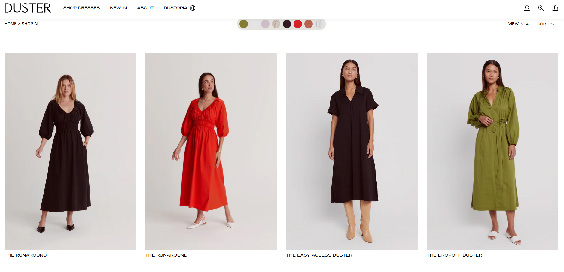
In summer 2023, Magsaysay made her most significant departure from journalism: she co-founded Duster, a fashion brand built around the Filipino house dress.
The traditional duster is what women in the Philippines wear at home because of the heat—comfortable, practical, but not something you’d wear to a meeting or event.
The concept behind Duster addresses a practical problem: women need clothing that works across contexts. “We’re running to lunch with a girlfriend or a business meeting, and then we have to go do school pickup, right? So I don’t want to think about changing. I want to wear one thing,” Magsaysay says.
But Duster is also addressing something deeper—visibility and value. The traditional duster symbolized care and caregiving, but was confined to the domestic sphere. Magsaysay’s version says: the work of care and the work of leadership aren’t separate. You can be comfortable and be taken seriously. As Magsaysay describes them: “Not floaty, moomoo-y, just like a little more sophisticated and elevated and modern.” In building Duster, Magsaysay brings her journalist’s understanding of storytelling to brand building. “How do you even make this a brand in the same way that’s going to resonate with somebody?” she asks. “Why am I going to think about that brand? Why am I going to buy that brand?”
AI, Adaptation, and the Future of Creative Work
Magsaysay’s relationship with artificial intelligence reveals her characteristic pragmatism about industry disruption. She’s lost contracts to AI—a startup founder recently told her she’d use AI for copywriting because “I don’t need it to be amazing, it needs to just be good enough.” “I totally agree with her by the way, for a startup you’re very scrappy with your funds,” Magsaysay says, without bitterness.
But simultaneously, she’s an advisor to Illuminate AI, a company using spectroscopy—the science of light—to revolutionize how beauty products are matched to skin tones. The technology drowns out ambient light when you take a selfie, accurately reading your skin tone and undertone regardless of lighting conditions.
“Something like 90% of women wear the wrong foundation shade,” Magsaysay notes. The beauty industry, a $500 billion sector, has been operating essentially blindfolded, relying on consumers to self-report their skin tone using subjective descriptors. Illuminate AI uses science to solve this problem, creating better data for consumers and better product development insights for brands. Magsaysay’s role? Translating the science for consumers and connecting the startup with editors and publications, helping tell the story in ways that resonate beyond papers and academic journals.
“So yes, I am losing work to AI, but I am also figuring out ways to get work through AI,” she says. This flexibility—the ability to see how technology changes the landscape and find your place in the new terrain—echoes her career.
The Through-Line: Remaining Curious
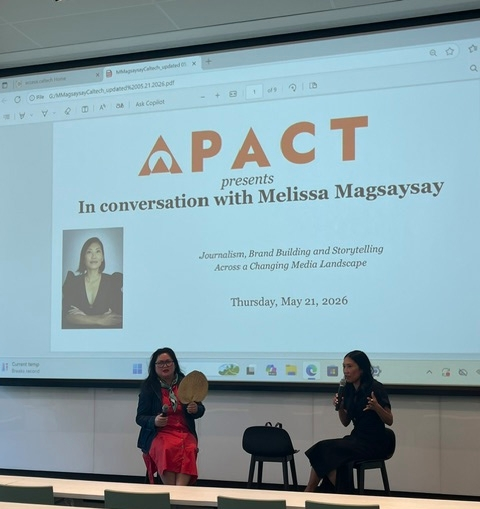
Speaking to students and researchers at Caltech—an audience of scientists and engineers—Magsaysay identified the common thread: curiosity. “I think the through line for me is curiosity. I’m sure you guys are all hyper curious people. It’s like what fuels what you do,” she told them. “That is what helps me evolve into other forms of media, new media. I still do write and participate in legacy media, but just remaining open and figuring out different ways to be a storyteller and reach an audience and highlight what someone might be doing that I think is interesting.”
It’s why she noticed the Filipino excellence emerging across fashion before it became a trend story. It’s why she saw the potential in Los Angeles when New York editors dismissed it. It’s why she understood that the duster could be more than housewear. In her podcast “Living Well,” this curiosity manifests as conversations with founders, doctors, plastic surgeons, longevity specialists, and beauty innovators—many of them AAPI leaders like Tower 28 founder Amy Liu or Jennifer Aniston’s trainer Dani Coleman.
The Exhaustion and the Reward
Magsaysay is frank about the costs of working in an industry driven by relentless newness. When asked if she gets tired of the hustle, she doesn’t hesitate: “Yes.”
“The consumer demand for newness and speed is insane,” she explains. “Insane. Unless it’s like a steep discount, the only thing that’s moving the needle for your business from an e-commerce standpoint is new.” This creates a capital-intensive environment with smaller margins where brands must constantly produce content that signals innovation, whether or not actual innovation is happening. It’s exhausting for creators, brands, and arguably for consumers too.
But Magsaysay also recognizes that “if you’re very intentional about, you know what, we’re going to really create this like very focused campaign and it’s going to be beautiful and it’ll be this, and it’s intentionally slow and drawn out… you can kind of still cut through the noise and do something different rather than compete with speed.”
The Door Is Still Open
Twenty years after standing outside a Manhattan nightclub with a clipboard, Magsaysay is still, in a sense, managing a door. But instead keeping people out, she opens spaces for voices and stories that fashion media has historically excluded.
She has a point of view. and in an industry often criticized for superficiality, a clear point of view—about who matters, what stories need telling—might be the most valuable commodity of all. The door is open. Melissa Magsaysay is still deciding what’s worth letting through.