
How Did I Learn to Say Goodbye?

(Photo: Kim Smith)
The first thing you learn is how to say goodbye.
Again. And again. And again — until the word frays at its edges like the hem of a coat worn through too many winters.
At the beginning, it hurts the way only first wounds can hurt: cleanly, without anesthesia, without warning. You are still small enough that the suitcase looks enormous beside you. You do not yet realize that each farewell is quietly rearranging the furniture of your soul — pushing the armchair of childhood into a darker corner, drawing curtains across rooms you used to play in.
You are a girl in a school uniform, somewhere in that tender country between childhood and whatever comes after, when you first understand the terms of the bargain. To follow your dreams, you must leave the country that bore you. So you pack a backpack — books with cracked spines, notebooks full of half-thoughts in blue ink, ambitions far too vast for canvas — and you carry them out the door as though they weighed nothing at all.
For me, travel has always been a swing in an empty garden. You climb on. The chains are cold in your palms. You push off with your legs, and the world tilts — sky, then earth, then sky again — and you hurl yourself into the open air with no real notion of where the arc will set you down. And still, you love it. Because that slow oscillation is the closest thing to flight a human body is permitted. For one suspended heartbeat, the whole world holds its breath for you.
But once you have tasted that altitude, the earth feels smaller. You find the ground unforgiving; nothing there can match the adrenaline of the apex, nothing there can speak the language your blood has just learned.
That is how it began. My first crossing into America — the long flight, the cold light of an unfamiliar airport, the strange new alphabet of street signs. Then the United Kingdom, with its rainy punctuation, its red buses moving through grey afternoons. Then the scattered cities of Europe, each a new height in the swing’s arc, each one teaching me a different way to be a stranger.
Travel gives you exactly the rush you were searching for. And yet, it asks for everything in return: you may never truly look back. And still I go.

(Image: Dreamstime)
I carry their voices with me like relics sewn into the lining of my coat. My mother’s voice was warm as bread just out of the oven. My father’s voice, low and steady, the kind of voice you could build a house against. My brother’s voice, light and teasing, was always one breath away from laughter. The small, indignant bark of my dog, who never understood why suitcases existed. And the dark, patient eyes of my horses saying goodbye, or perhaps only until soon, in that wordless language animals seem to know better than we ever will.
On my first true departure — my first academic pilgrimage — I tried to do it the way they do it in films. I walked through security. I turned around. I waved until the people I loved became silhouettes, then specks, then nothing at all — until the crowd swallowed them whole and the fluorescent lights of the terminal washed everything flat and pale.
That was the first time. After that, I learned to fold the ache inward, to seal it shut behind the ribs. I learned the quiet alchemy of turning grief into momentum. There are students — international ones, American ones, all kinds of ones — who keep returning home because something inside them still hums with belonging. A steady summoning. A homeward gravity. The pull Dante once gave a name to, when he wrote of exile as a wound that never quite closes, of bread that tastes of salt in another’s house.
I have never known that pull.
What I have known is the opposite hunger: the longing for altitude, for sky, for distance from anything I might be tempted to call normal. Because the moment a place begins to feel normal, it also begins to harden. Into routine. Into tedium. Into the slow terror of becoming rooted — of having my wings folded neatly and put away in a drawer that someone else will eventually lock.
To belong, I learned early, is to give a place permission to hurt you. Trusting is to hand someone the map of your softest country and hope they do not march across it in heavy boots. So, I built a smaller country inside myself, one with no borders open to visitors, and I have lived there ever since, alone but unbreeched.
And so I learned to say goodbye. I straighten my neck. I straighten my back — always aching, always carrying something invisible and heavy — and I walk. I walk toward the next gate, the next adventure, the next bright illusion that I half-suspect will dissolve like sugar in my hands the moment I try to hold it.
I told myself I had to go. I had to do the research. Build the profile. For what? I asked it like a prayer with no listener, and I answered it with another goal, and another, and another — each one a stepping stone in a river that has no other shore.
Because the truth — the thing I was actually chasing through every airport, every acceptance letter, every fluorescent-lit library at three in the morning — was simply a sense of belonging. The kind of belonging that lets you set down your keys at the end of the day and trust the table to still be there in the morning. And I have not found it. I no longer believe I will.
So I learned to say goodbye.
And adventure by adventure, each one took a small, careful slice of my heart, until now there is only the cool architecture of the next plan, the next task, the next step forward.
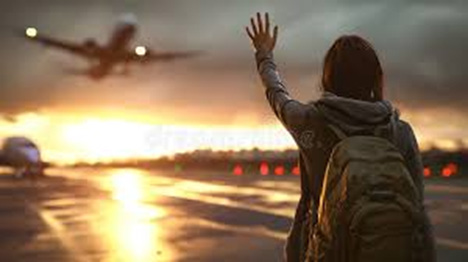
(Image: Dreamstime)
And then, without warning, memory ambushes me. It comes in fragments, always the corners, the edges, the small holy details that no photograph ever bothered to capture. My father, fresh from the shower — too much aftershave, too much man, a bathroom floor always somehow flooded in his wake, as if he carried small weather systems with him wherever he went. The faint, comforting chaos of him.
My mother’s chenille robe, impossibly soft against my cheek when I would press my face into her shoulder. The scent of roses, yes — but beneath the roses, something the perfume could not name. The scent of mother. The scent that means home in a language no dictionary has ever printed.
My brother’s gentle voice, always armed with a joke or a tender, animated sermon about football, his eyes bright with the kind of certainty only older brothers can carry. His hands inexplicably, eternally damp; I am a biologist, and I have given up asking why.
The velvet ears of my little dog, framing eyes so dark and so kind they seemed to hold ancient knowledge. The way he would curl beneath my desk while I studied, his small ribs rising and falling, his snoring the most loyal soundtrack a girl could ask for. How the room felt incomplete without that soft rhythm. How silence, since then, has never sounded quite the same. And Orchidea — my mare, now in her quiet retirement, grazing somewhere in a field I can only visit in my mind. The smell of her — hay and sun-warmed leather and that sweetness of horse, which is the smell of childhood for anyone who has ever loved one. The way she would lower her great head into my chest, trusting me with the most fragile gesture in the animal world.
My uncle, forever ready with a punchline, forever conducting his gentle, stubborn conspiracy to slip me one more glass of something — wine, amaro, whatever the occasion offered — laughing as he poured, as though laughter itself were the real drink.
To all of this, every single day, I say goodbye.
It repeats in my head like a litany. Like a small bell had rung in an empty chapel at dusk, when no one was listening but the dust in the air and the long shadows on the floor. And with every chime, another fragment of my heart loosens, lifts, and is carried off — somewhere I cannot follow, somewhere I am not yet brave enough to call home. The swing is still moving. I am still in the air. The arc has not yet finished, and perhaps it never will.
And somewhere, far below, in a garden I left a long time ago, there is a small girl with a backpack too heavy for her shoulders, still waving — at me, at herself, at the woman she became — and she is smiling, just slightly, as though she already knew.