
Senator Adam Schiff Goes Down the Quantum Rabbit Hole at Caltech
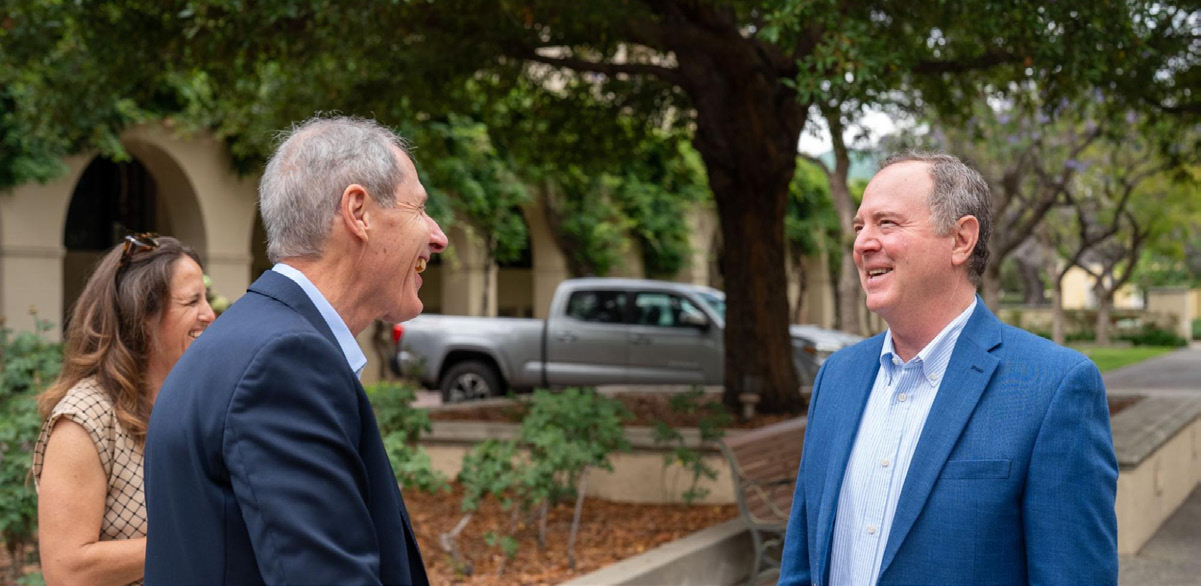
Senator Adam Schiff is greeted by Caltech Chief Communications Officer Shayna M. Chabner McKinney and Caltech President Thomas F. Rosenbaum. (Photo: Erin Byers)
On May 27, California Senator Adam Schiff visited Caltech for a tour that moves from the hardware of quantum computing to the philosophical puzzles of quantum mechanics. Schiff, joined by his wife Eve, toured Professor Manuel Endres’ lab, met with President Thomas F. Rosenbaum, and spoke with John Preskill about entanglement, hidden variables, many worlds, time travel, and what Feynman might have thought of AI-generated Feynman lectures.
Schiff came to campus not as a passive dignitary, but as a self-described quantum enthusiast. Asked what brought him here, Schiff said he has long been fascinated by quantum mechanics, “and by entanglement in particular.” As the former chair of the House Intelligence Committee, he said, he received briefings on quantum computing and watched the field move from long-range possibility toward technological reality.
“I remember briefings from a decade ago, when there was still a great deal of technological uncertainty and profound questions about whether this was really doable — whether it was some phantom we would be chasing for decades,” Schiff said. “Now it feels much closer to becoming a real, viable quantum technology. It is fascinating to see what that looks like in the lab, to be on campus, and to be on the brink of these discoveries.”
That brink, in Endres’ lab, looks like lasers, optical control, safety goggles, and the painstaking work of turning atoms into reliable carriers of quantum information. The tour included a look at in-lab optical qubit control, as well as discussion of quantum error correction, one of the central challenges facing the field.
The visit also gave Schiff a chance to connect scientific ambition with federal policy. Asked how Congress should protect long-horizon science from short-term budgetary politics, he argued that the United States’ scientific strength has depended on attracting talent from around the world.
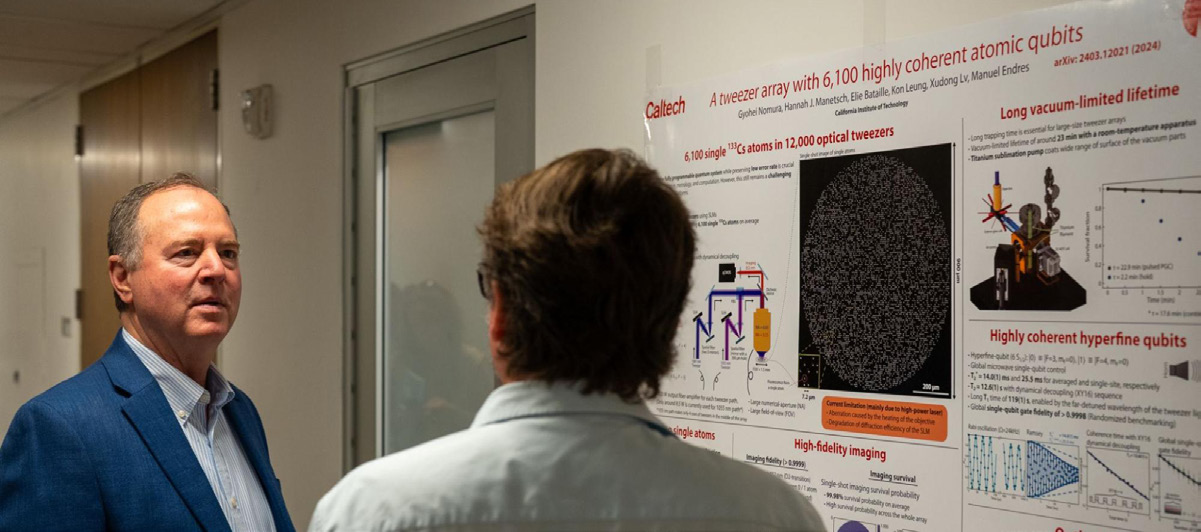
Senator Schiff listens as Professor Manuel Endres describes recent research from his lab on their 6,100-qubit tweezer array. (Photo: Erin Byers)
“What has always helped this country prosper is our ability to attract the best and brightest minds,” Schiff said. “I saw that in the lab today, with scientists from Japan and Germany. I saw it all the time at JPL: our institutions have been magnets for brilliant people from around the world because of the strength of American science.”
He warned that this advantage is precarious. Recalling a conversation at Reagan National Airport with a recent Johns Hopkins STEM graduate planning to work at NASA, Schiff said he told the graduate that NASA was facing a difficult budget moment. The student replied, according to Schiff, that in his entire graduating class, he was the only one who was not leaving the country.
“That was heartbreaking,” Schiff said. “We are not only failing to attract some of the best and brightest minds; many are deciding to leave because of the perception of hostility toward science.”
For Schiff, quantum computing sits at the interface of discovery, economic policy, and national security. Like artificial intelligence, he said, quantum technologies carry both promise and risk. They may enable new forms of computation, new approaches to privacy, and major advances in fields such as healthcare. But they may also threaten existing encryption systems and create new vulnerabilities.
“That is why it is so important to stay ahead in this race,” Schiff said, “to develop the best defenses possible and to be prepared for anything.”
After the lab tour, the visit shifted from quantum engineering to quantum interpretation. In a conversation with Preskill and Rosenbaum, Schiff asked about entanglement, hidden variables, the double-slit experiment, many worlds, and quantum cosmology — the kind of conceptual terrain that has made Caltech a natural home for both Feynman lore and modern quantum information.
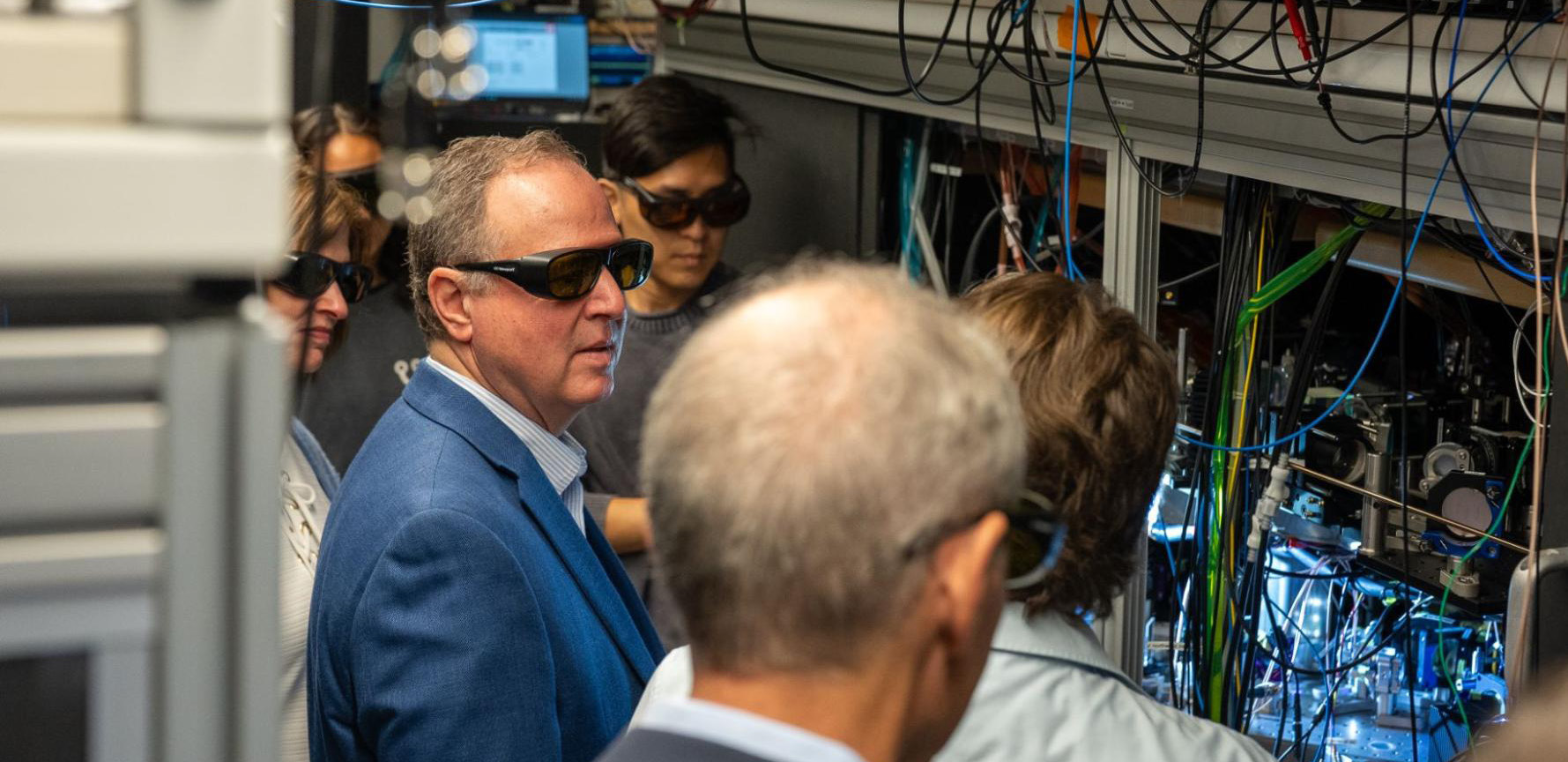
Senator Schiff, in safety goggles, watches as the Endres lab’s optical quantum computing apparatus is demonstrated. (Photo: Erin Byers)
Preskill sketched why entanglement isn’t just the quantum version of opening two boxes and finding paired mittens: Bell-type experiments rule out any ordinary picture in which the answers were simply fixed in advance. Rosenbaum, speaking as what he called a “prosaic experimentalist,” emphasized that measurement is not a mystical act of human attention, but a physical interaction that irreversibly correlates a system with its environment.
The conversation ranged from decoherence to many worlds, with Preskill describing measurement as a process in which the observer becomes entangled with the system observed. Schiff distilled this with admirable economy: “My takeaway is Spider-Man is real.”
Preskill also pointed to quantum gravity and the origin of the universe as among the field’s deepest open questions. Physics can trace cosmic history back remarkably far, he said, but eventually reaches a regime where spacetime itself fluctuates and familiar descriptions break down.
The setting — Bridge’s Richard P. Feynman Lecture Hall — added its own resonance. Schiff noted the thrill of being in a room associated with Feynman, whose lectures he had listened to with reverence. Preskill, who overlapped with Feynman for four years, recalled him as charismatic, deeply curious, and full of stories. Asked what Feynman would think of AI-generated Feynman lectures, Preskill said he would likely be “rather appalled.”
By the end, Schiff joked that he would like course credit. Preskill replied that the senator was ready for a PhD: “Those were great questions.”
That exchange captured the odd charm of the visit. Schiff came to Caltech with the public responsibilities of a senator: funding, national security, immigration, technological competitiveness. But he also came with the inquisitiveness of someone genuinely bothered (in the best way) by the conceptual strangeness of quantum mechanics. The result was a campus visit in which policy didn’t flatten science into talking points, and science didn’t retreat into abstraction. Rather, for a morning, quantum computing was both a national priority and a metaphysical rabbit hole — both laboratory hardware and a question about what it means for the world to become knowable.
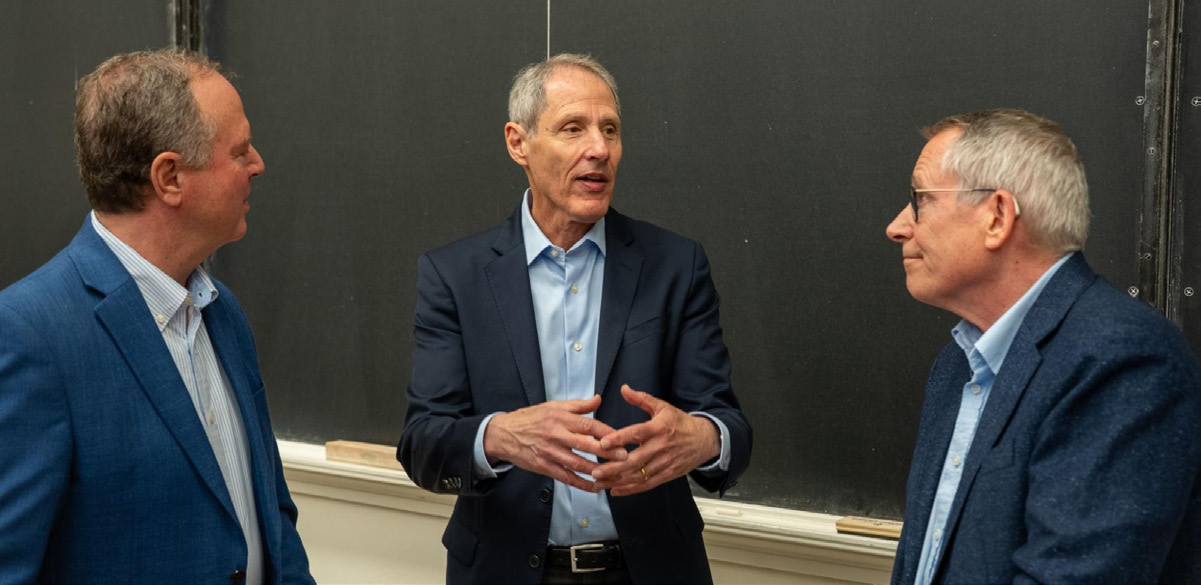
Senator Schiff talks hidden variables, many worlds, and quantum measurement with President Rosenbaum and John Preskill, Richard P. Feynman Professor of Theoretical Physics. (Photo: Erin Byers)